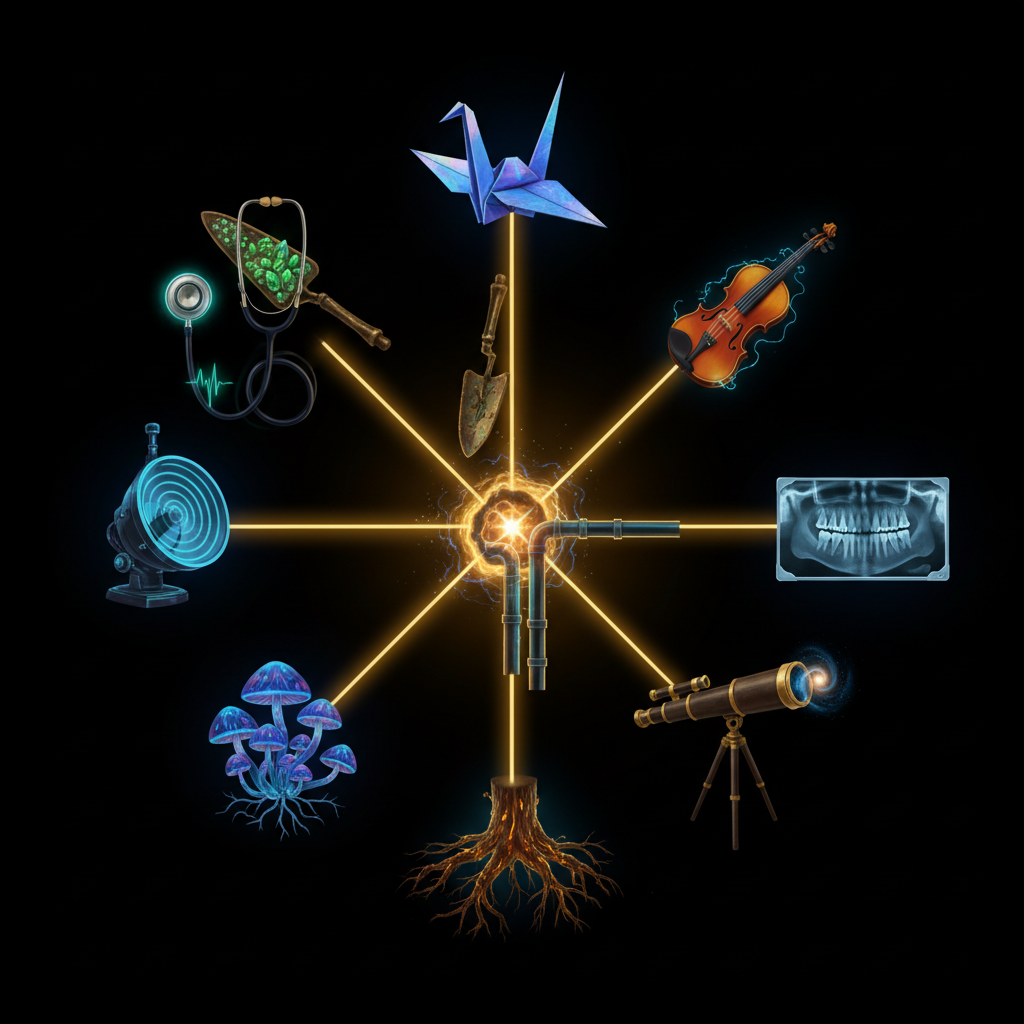
Disciplinary silos prevent knowledge transfer. A feature, not a bug: This isolation forced us to harvest detection principles from nine unrelated fields — because the mechanism is domain-agnostic.
Lateral Principle Transfer: Unexpected Domains -> Underground Detection
Location: Wilmersdorfer Strasse, Berlin-Charlottenburg Date: 2026-03-25 Method: 9-expert cross-domain panel, each from a wildly unrelated field Premise: The Mouthwash Principle -- mechanisms transfer even when domains do not
The Mouthwash Principle
A person with smelly sport shoes pours mouthwash on them. The product is wrong-domain (oral hygiene). The principle is right-domain (kill odor-causing bacteria). The antibacterial mechanism is domain-agnostic.
Every field has independently solved the problem of "find hidden things you cannot see." The mechanisms they invented are domain-agnostic. We harvest those mechanisms and apply them to underground infrastructure detection in Berlin.
The question for each expert: What principle from your field, when stripped of its domain-specific packaging, becomes a powerful tool for finding pipes, cables, and voids under Wilmersdorfer Strasse?
Transfer Map
SOURCE DOMAIN          PRINCIPLE                           UNDERGROUND APPLICATION
=================================================================================
Oncology          -->  Risk-based screening triage     --> Priority-ranked survey segments
                  -->  Biomarkers before symptoms      --> Chemical "blood test" of soil/air
                  -->  Contrast agents for imaging     --> Tracer injection into pipes
                  -->  Multi-modal screening           --> GPR + EMI + thermal fusion

Sommelier         -->  Terroir (surface reflects below) --> Pavement cracks = underground taste
                  -->  Blind tasting elimination       --> Systematic utility identification
                  -->  Blending for richness           --> Multi-sensor data fusion
                  -->  "The nose" (aroma profiling)    --> Electronic nose gas arrays

Archaeology       -->  Cropmarks from aerial photos    --> NDVI drone imagery over pipes
                  -->  Non-invasive geophysics         --> Same methods, different targets
                  -->  Stratigraphy (layer reading)    --> Utility burial depth layers
                  -->  Timing matters (season/weather) --> Survey after rain/frost/heat

Blindness         -->  Echolocation                    --> Ambient acoustic reflection sensing
                  -->  Tactile surface reading          --> Vehicle accelerometer road scanning
                  -->  Trained guide dogs              --> Sniffer dogs for gas/water leaks
                  -->  Spatial memory from non-visual  --> Map-building from non-optical data

Music Production  -->  Equalization (freq filtering)   --> Isolate pipe-specific frequencies
                  -->  Reverb = room characterization  --> Void acoustic signatures
                  -->  Stereo imaging / beamforming    --> 3D acoustic source location
                  -->  Side-chain (known -> unknown)   --> Traffic noise deconvolution

Immunology        -->  Immune surveillance (constant)  --> Continuous IoT sensor network
                  -->  Antibodies = specific detectors --> Each sensor targets one signal
                  -->  Inflammation = local response   --> Adaptive sensor deployment
                  -->  Contact tracing in networks     --> Cascading failure propagation

Perfumery         -->  Olfactory fingerprinting        --> Chemical signature per pipe type
                  -->  Volatility ordering (top notes) --> Gas arrival time = depth estimate
                  -->  Headspace analysis              --> Manhole gas sampling
                  -->  Concentration gradient tracking  --> Follow gradient to leak source

Fishing           -->  Read water surface for depth    --> Read pavement surface for buried
                  -->  Fish finder echo interpretation --> "What type, how deep, what state?"
                  -->  Bait and detect                 --> Tracer injection to attract sensors
                  -->  Tides = unseen forces, surface  --> Pressure/thermal surface effects

Martial Arts      -->  Listening energy (precursors)   --> Precursor vibration before failure
                  -->  Stillness = sensitivity         --> Passive > active sensing
                  -->  Qi flow (energy channels)       --> Pipe networks ARE energy channels
                  -->  Empty space is data             --> Negative evidence = informative
1. Oncology -> Infrastructure Health Screening
The Principle
Cancer screening does not scan every cell in the body -- it uses risk-based triage. Age, family history, genetic markers, and lifestyle factors determine who gets screened, how often, and with which modality. A 25-year-old with no family history does not get the same protocol as a 60-year-old BRCA carrier.
The Transfer
Wilmersdorfer Strasse has ~15 km of mixed utilities. Scanning everything with GPR at high resolution would cost hundreds of thousands of euros and weeks of work. Instead, apply oncological triage:
Risk Factors for Underground "Cancer" (pipe failure):
- Age (pipe installation year): Pre-1945 cast iron = highest risk. 1960s asbestos cement = high risk. Post-2000 PE = low risk.
- Material ("genetic predisposition"): Cast iron corrodes. PVC becomes brittle. Steel rusts. PE is resistant.
- Soil type ("environmental exposure"): Sandy soil = low corrosion. Clay = high. Berlin's glacial sand/gravel is mixed.
- Previous failures ("family history"): Streets with prior main breaks get priority.
- Proximity to critical loads ("comorbidities"): Pipes under tram tracks or heavy traffic degrade faster.
Screening Protocol:
- Level 1 (population screening): Desk review of all utility records + satellite thermal imagery. Cheap. Covers everything.
- Level 2 (targeted screening): GPR survey of high-risk segments identified in Level 1. ~30% of street length.
- Level 3 (diagnostic workup): Multi-sensor fusion (GPR + EMI + acoustic) on anomalies from Level 2. ~5% of street length.
- Level 4 (biopsy): Targeted potholing/excavation at confirmed anomalies. <1% of street length.
Biomarkers -- The "Blood Test" of the Street: Every failing pipe leaks something detectable BEFORE catastrophic failure:
| Pipe Type | "Biomarker" | Surface Detection Method |
|---|---|---|
| Water main | Chlorine in soil | Chlorine sensor at manholes |
| Gas main | Mercaptan / methane in air | Laser methane detector |
| Sewer | H2S in manhole air | H2S sensor array |
| District heating | Thermal anomaly at surface | Thermal drone flyover |
| Corroding iron | Rust in groundwater | Water sampling at drainage points |
Contrast Agents -- Making the Invisible Visible: Oncologists inject gadolinium or iodine to make tumors glow on MRI/CT. The underground equivalent:
- SF6 tracer gas injected into gas mains, detected at surface with laser analyzer
- Fluorescent dye in water mains, detected at leak points under UV
- Electromagnetic tracer balls (smart pigs) inserted into pipes, tracked from surface
Has Anyone Done This?
YES -- extensively.
Pipe risk scoring with machine learning is a mature field. Gradient Boosted Decision Trees and Random Forest models use pipe age, material, soil type, diameter, and failure history to predict failure probability. Studies confirm that pipe material, number of previous bursts, and age are the three strongest predictors (Nature - npj Clean Water, 2022). The US Pipeline and Hazardous Materials Safety Administration (PHMSA) publishes formal risk modeling guidance (PHMSA, 2020).
Tracer gas detection with SF6 and helium is commercial technology (Forensics Detectors, 2026). Fluorescent dyes for sewer and water leak tracing are a standard product.
Genuine Innovation Opportunity: Nobody has combined the FULL oncological screening cascade (population -> targeted -> diagnostic -> biopsy) as a formal framework for utility survey prioritization. The individual tools exist; the systematic triage protocol does not.
Feasibility: 9/10
All component technologies are commercial. The innovation is in the systematic protocol design.
2. Sommelier -> Multi-Sensory Underground Tasting
The Principle
A master sommelier identifies a wine's grape variety, region, vintage, and quality through systematic multi-sensory elimination: color (visual), nose (olfactory), palate (gustatory), and structure (tactile). No single sense is sufficient. The COMBINATION is diagnostic. And critically, the wine's terroir -- the soil, climate, and geology where it grew -- is detectable in the final product.
The Transfer
Terroir Principle -- The Surface Reflects the Subsurface: Just as wine expresses its terroir, the pavement surface above Wilmersdorfer Strasse expresses the infrastructure beneath it:
- Pavement patches = previous utility excavations (the "label" on the bottle)
- Linear cracks = differential settlement over pipe trenches
- Moisture staining = water leak below
- Vegetation strips = pipe trench with different soil (the "cropmark")
- Temperature patches = district heating or steam pipe below
A trained "infrastructure sommelier" reads these surface expressions the way a sommelier reads color, legs, and aroma.
Blind Tasting Protocol -- Systematic Elimination: When a sommelier encounters an unknown wine, they do NOT guess immediately. They follow a deductive tasting grid:
- Color/clarity -> general category (red/white/rose = water/gas/electric/telecom)
- Nose -> specific characteristics (primary/secondary/tertiary aromas = chemical signature)
- Palate -> structure confirmation (acid/tannin/body = depth/diameter/material)
- Conclusion -> final identification (grape/region/vintage = pipe type/operator/install date)
Transfer to utility identification:
- Depth reading (GPR) -> general category (shallow = telecom, medium = gas/water, deep = sewer)
- Material signature (EMI response) -> specific type (metallic/non-metallic, ferrous/non-ferrous)
- Diameter estimate (GPR hyperbola width) -> size confirmation
- Operator attribution -> cross-reference with records
The "Nose" -- Electronic Nose Arrays: A sommelier's nose detects hundreds of volatile compounds simultaneously. Transfer: deploy multi-gas electronic nose (e-nose) arrays at street furniture (lampposts, bollards, benches) along Wilmersdorfer Strasse. Each sensor array simultaneously monitors:
- Methane (gas leak)
- H2S (sewer)
- Chlorine (water)
- CO (combustion)
- Mercaptan (gas odorant)
The COMBINATION of gases at each point creates a unique "aroma profile" that maps the underground infrastructure.
Blending -- Data Fusion: Great wines are blends. Great underground maps are blends of sensor data. No single sensor type provides a complete picture, but fusing GPR + EMI + acoustic + thermal + chemical creates a richer "flavor" than any individual source. Research confirms that multi-sensor fusion using marching cross-section algorithms and Kalman filters significantly improves utility map accuracy (Academia.edu - Detection and localization of underground networks by fusion).
Has Anyone Done This?
Partially. Multi-sensor data fusion for underground utilities is an active research area. The EU COST Action TU1208 (Civil Engineering Applications of GPR) promoted exactly this. E-nose technology for gas detection exists commercially, but nobody has deployed permanent multi-gas sensor arrays on street furniture for continuous underground infrastructure monitoring. The "sommelier tasting grid" as a formal decision protocol for utility identification has not been published.
Genuine Innovation Opportunity: Permanent multi-gas sensor arrays on existing street furniture (Berlin has lampposts every 30m on Wilmersdorfer Strasse), creating a persistent "aroma map" of the underground.
Feasibility: 7/10
Individual sensors exist. Integration into street furniture is engineering, not science. The gap is nobody has built the integrated system.
3. Archaeology -> Proven Methods We Are Ignoring
The Principle
Archaeology invented non-invasive subsurface detection. For decades before GPR was commercialized for utility detection, archaeologists were using resistivity surveys, magnetometry, and aerial photography to find buried walls, ditches, roads, and tombs WITHOUT excavation. They also discovered that timing matters enormously -- the same field photographed in different seasons reveals different buried features.
The Transfer
Cropmarks and Vegetation Anomalies: Archaeologists discovered that crops grow differently over buried features: taller and greener over moisture-retaining ditches, shorter and yellower over stone walls. This principle transfers directly:
- Water pipe leaks create lusher vegetation strips detectable by NDVI (Normalized Difference Vegetation Index) from drone or satellite imagery
- Gas pipe leaks create stressed/dying vegetation strips
- Pipe trenches (backfilled with different soil) create subtle vegetation differences
Satellite-based pipeline leak detection using vegetation indices is now commercial. Satelytics' PipeWatch system found a leak five days before the operator knew by analyzing vegetation change from satellite imagery (Satelytics Case Study). Drone-mounted multispectral cameras produce NDVI at cm resolution.
Caveat for Wilmersdorfer Strasse: It is a pedestrian shopping zone (since the 1970s), so vegetation is limited to planted trees and planter boxes. However, nearby side streets with tree-lined sidewalks ARE candidates for vegetation analysis.
Archaeological Timing -- When to Survey: Archaeologists know that the SAME field looks completely different depending on when you survey:
- After drought: Buried features cause differential soil moisture, visible from air
- After frost: Frozen ground reveals thermal differences over buried structures
- After plowing: Fresh soil disturbance reveals color differences
- Early morning: Dew/frost patterns highlight buried walls
Transfer to Berlin utilities:
- After rain: Moisture seepage patterns reveal leaking water mains
- During winter (December-February): Thermal infrared clearly shows district heating pipes (hot lines in cold ground)
- After frost heave (March): Differential settlement over pipe trenches becomes visible as pavement cracks
- Early morning (before traffic): Thermal signatures strongest before sun and traffic warm the surface uniformly
Stratigraphy -- Utility Layer Cake: Archaeologists understand stratigraphy: layers deposited over time, newest on top. Berlin's underground has its own stratigraphy:
- 0.3-0.5m: Telecom ducts, low-voltage electric
- 0.6-0.8m: Gas mains
- 0.8-1.2m: Water mains
- 1.0-1.5m: District heating
- 1.5-3.0m: Sewer mains, high-voltage electric
- 3.0m+: U-Bahn tunnels, deep drainage
Knowing this layer model helps interpret GPR data the same way knowing the local stratigraphy helps archaeologists interpret resistivity data.
Resistivity Survey: Archaeological resistivity surveys detect buried stone walls (high resistivity) and water-filled ditches (low resistivity). Transfer: detect metallic pipes (conductors), plastic pipes (insulators), water-filled voids (low resistivity), and air-filled voids (high resistivity). The University of Durham has been doing this since the 1960s (Durham University Archaeological Services).
Has Anyone Done This?
YES -- archaeology and utility detection share the SAME TOOLS. The transfer has already happened, but incompletely. Key gap: utility surveyors almost never use aerial/satellite vegetation analysis or timing-optimized surveys -- techniques that are STANDARD in archaeology. A comprehensive review of geophysical data acquisition methods for underground feature detection confirms the archaeological heritage of these methods (ScienceDirect, 2025).
Genuine Innovation Opportunity: Timing-optimized surveys (seasonal, weather-dependent, time-of-day) are standard in archaeology but almost never applied to utility detection. A "survey calendar" for Wilmersdorfer Strasse -- thermal in January, NDVI in June, moisture after October rains -- would be novel.
Feasibility: 9/10
All methods are proven. The innovation is applying archaeological BEST PRACTICES that the utility industry ignores.
4. Blindness -> Sensing Without Seeing
The Principle
People who cannot see develop extraordinary abilities to sense their environment through other modalities: echolocation (clicking and listening to echoes), tactile sensing (reading Braille at 100+ words/minute through fingertips), spatial memory built from non-visual cues, and heightened awareness of sound reflections. Some use guide dogs whose senses extend the person's perceptual range.
The Transfer
Echolocation -- Listening to the City: Human echolocators click their tongues and interpret echoes to "see" objects, walls, and openings. Transfer: the city is ALREADY making noise (traffic, construction, pedestrians). That noise bounces off underground structures. We just need to LISTEN.
Distributed Acoustic Sensing (DAS) does exactly this. Existing telecom fiber-optic cables buried under streets act as thousands of microphones. Traffic noise passing through the ground interacts with buried structures. By cross-correlating the ambient noise recorded along the fiber, researchers extract shallow subsurface velocity profiles that reveal underground features.
A landmark study used a 5.2 km telecom fiber-optic cable in an urban area as a DAS array, recording ambient noise from traffic, and successfully imaged shallow structures (top 30m) using noise interferometry (Surveys in Geophysics, 2021). Dark (unused) fiber has been repurposed as seismic sensors over 27 km sections (Nature Scientific Reports, 2018).
Berlin has fiber-optic cables under virtually every street, including Wilmersdorfer Strasse. This is the most powerful single transfer in this entire report: existing telecom infrastructure becomes a free, permanent, distributed underground sensor.
Tactile Sensing -- The Road as Braille: A blind person reads Braille by feeling surface texture. Transfer: vehicles driving over Wilmersdorfer Strasse "read" the pavement surface through their vibrations. Vehicle-mounted accelerometers detect potholes, cracks, settlement, and subsurface anomalies. Research confirms that accelerometers may detect internal damage of pavements before it appears on the top surface (ResearchGate - Vehicle Vibration Signal Processing). Berlin's buses and delivery vehicles already carry GPS and accelerometers in smartphones. This data already EXISTS.
Guide Dogs -- Sniffer Dogs for Infrastructure: This is NOT metaphorical. Trained sniffer dogs detect underground pipe leaks in operational programs worldwide:
- Water leaks: Dogs trace chlorine smell, achieving 90-96% accuracy, detecting leaks up to 4m deep. Approximately 20 sniffer dogs are deployed worldwide for water leak detection (IWA Publishing - Water Supply, 2023)
- Gas leaks: Dogs trained on mercaptan outperform electronic detectors by detecting parts per BILLION vs. parts per million. Chevron's "pipeline pups" program locates tiny pipeline leaks (Chevron, 2024)
- K9 Pipeline Training Academy trains dogs specifically for pipeline leak detection (K9PTA)
- The Sniffers (Netherlands-based company) operates a dedicated dog division for pipeline leak detection (Oil and Gas Technology)
Spatial Memory from Non-Visual Cues: Blind people build rich mental maps from sound, touch, smell, and proprioception -- never from vision. Transfer: build a complete underground map from non-visual data sources (acoustic, thermal, electromagnetic, chemical, vibration) and NEVER rely on a single "visual" sensor like GPR.
Has Anyone Done This?
YES -- all of these are operational technologies:
- DAS on telecom fiber: proven in multiple cities globally
- Vehicle-mounted accelerometers for pavement condition: deployed commercially
- Sniffer dogs: ~20 water leak dogs worldwide, plus gas pipeline dogs
- Multi-modal non-visual mapping: active research area
Genuine Innovation Opportunity: Crowdsourced pavement vibration data from Berlin's BVG buses. Every bus already has GPS and accelerometers. The data exists. Nobody is mining it for underground infrastructure signatures. A partnership with BVG to access this data could create a continuous, free, city-wide subsurface monitoring system.
Feasibility: 8/10
DAS on existing fiber is proven but requires access agreements with telecom operators. Sniffer dogs are operational. Bus data is technically accessible but requires institutional partnership.
5. Music Production -> Signal Processing Underground
The Principle
A music producer's daily work is manipulating invisible signals: boosting wanted frequencies, cutting noise, locating sounds in 3D space, characterizing rooms by their reverb, and extracting faint signals from overwhelming backgrounds. Every one of these operations has a direct underground analog.
The Transfer
Equalization (EQ) -- Frequency Filtering for Pipes: A producer boosts vocals at 2-5 kHz and cuts rumble below 80 Hz. Transfer: underground signals have characteristic frequency bands:
- Water flow in pipes: 200-800 Hz
- Gas flow: 50-200 Hz
- Electrical hum: 50 Hz (Europe) fundamental + harmonics at 150, 250, 350 Hz
- Sewer flow: broadband, low frequency
- Empty void resonance: depends on cavity size
By "EQ-ing" geophone data -- boosting the frequency band of interest and cutting everything else -- each utility type can be isolated from the noise floor.
Reverb Mapping -- Characterizing Underground Voids: Sound engineers characterize a room by its impulse response (clap, measure the reverb). A cathedral sounds different from a closet. Transfer: underground voids have acoustic signatures. A buried empty pipe resonates differently from a full one. A cave-in void has a different impulse response than solid ground. Sending a controlled impulse (hammer strike, vibrator) and recording the response characterizes the subsurface the same way an impulse response characterizes a room.
Stereo Imaging / Beamforming -- 3D Source Location: A producer places sounds in stereo/surround using phase and timing differences between channels. Transfer: acoustic beamforming with geophone arrays locates underground sound sources (leaks, flows, resonances) in 3D space. Research on seismic beamforming using distributed acoustic sensing arrays confirms this capability (ResearchGate, 2020).
Side-Chain Compression -- Using Known Signals to Extract Unknown Responses: In production, a kick drum signal controls the compressor on a bass, creating rhythmic pumping. The known signal (kick) shapes the behavior of the unknown (bass response). Transfer: use traffic noise (a known, measurable signal) as the "side-chain" input. The ground response to that known input contains information about the subsurface. This is formally called seismic deconvolution -- mathematically dividing the output by the input to get the transfer function (the ground's impulse response). Passive seismic imaging using DAS in Melbourne demonstrated this approach using urban traffic noise (GeoScienceWorld, 2024).
Noise Gating -- Removing Surface Noise: Noise gates close when signal drops below a threshold, silencing background noise between notes. Transfer: adaptive noise cancellation algorithms suppress surface noise (traffic, construction, wind) to isolate faint underground signals. This is standard in seismic processing but rarely applied to shallow urban utility detection.
Sonification -- Hear the Underground: Data sonification converts seismic data to audible sound. Seismic waves of different frequency and temporal characteristics are easily discriminated when time-compressed to the audio range (ResearchGate - Seismic Sound Lab). A technician wearing headphones, walking Wilmersdorfer Strasse with a geophone, HEARING the underground like a producer monitoring a mix -- is a viable operational technique.
Has Anyone Done This?
YES, but the FRAMING is novel. Seismic processing uses all these techniques (filtering, deconvolution, beamforming, noise cancellation). But they are described in seismological jargon, not audio engineering jargon. The conceptual mapping between music production and underground sensing has NOT been published as a pedagogical framework. More practically, sonification of utility survey data is almost completely unexplored.
Genuine Innovation Opportunity: Sonification of GPR/geophone data for real-time field interpretation. A technician "listening" to the underground while walking, using audio cues (pitch = depth, timbre = material, stereo position = lateral location) could be faster and more intuitive than staring at B-scan displays.
Feasibility: 7/10
All signal processing techniques are mature. Sonification requires UX development but no new science.
6. Immunology -> Infrastructure Immune System
The Principle
The immune system performs continuous surveillance of the entire body, deploys specific detectors (antibodies) for specific threats, concentrates resources at infection sites (inflammation), and tracks how infections spread through the body. It operates without central control -- distributed intelligence making local decisions.
The Transfer
Immune Surveillance -- Continuous Monitoring Network: The body does not wait for symptoms -- it monitors constantly. Transfer: deploy persistent IoT sensors in existing access points along Wilmersdorfer Strasse:
- Manholes: H2S, methane, temperature, humidity, water level sensors
- Valve boxes: Acoustic leak detectors, pressure sensors
- Lampposts: Air quality (methane, CO), ground vibration
- Building basements: Moisture sensors, radon detectors
This creates a persistent "immune system" for the street, detecting anomalies before failure.
Antibodies = Specific Detectors: Each antibody targets ONE antigen. Each sensor targets ONE infrastructure signal:
| "Antibody" (Sensor) | "Antigen" (Infrastructure Signal) |
|---|---|
| Methane detector | Gas pipe leak |
| Chlorine sensor | Water main leak |
| H2S sensor | Sewer deterioration |
| Acoustic correlator | Water flow / leak sound |
| 50 Hz EMF sensor | Live electric cable |
| Temperature probe | District heating leak |
Inflammation -- Adaptive Sensor Deployment: When the immune system detects a pathogen, it floods the area with white blood cells (inflammation). Transfer: when a fixed sensor detects an anomaly (elevated methane at a manhole), deploy ADDITIONAL mobile sensors to that location:
- Drone with thermal camera
- Mobile GPR unit
- Sniffer dog team
- Portable multi-gas analyzer
This "inflammatory response" concentrates sensing resources at the point of concern, rather than spreading them uniformly.
Contact Tracing -- Cascading Failure Analysis: Epidemiologists trace disease spread through contact networks. Transfer: infrastructure failures propagate through networks:
- A water main break undermines the soil around a gas main, causing a gas leak
- A sewer collapse creates a void that a road surface falls into
- An electrical fault heats a cable, which damages an adjacent telecom duct
Research confirms that cascading failures in interdependent infrastructure systems significantly increase geographic footprint beyond initial damage (ASCE, 2024). A comprehensive review catalogs disaster chain mechanisms across urban infrastructure (ScienceDirect, 2025).
Vaccination -- Predictive Prevention: The immune system prevents disease, not just treats it. Transfer: predictive maintenance models identify "at-risk" pipe segments BEFORE they fail. Machine learning on pipe age, material, soil condition, and failure history predicts which segments to replace proactively. This is cheaper than emergency repair. Smart IoT infrastructure frameworks integrate distributed sensors to enable real-time processing and predictive maintenance, transitioning utilities from reactive to proactive management (WJARR, 2025).
Has Anyone Done This?
YES -- IoT monitoring networks for utilities are deployed globally. Predictive maintenance with ML is a rapidly growing field. Cascading failure modeling is an active research area.
Genuine Innovation Opportunity: The adaptive sensor deployment concept (inflammation response) is not well-implemented. Most sensor networks are static. A system that automatically dispatches drone/mobile sensors when fixed sensors detect anomalies would be genuinely novel for urban utility management. Also, the contact tracing for infrastructure -- modeling failure propagation across utility types (not just within one network) -- is underexplored.
Feasibility: 8/10
Individual sensors and predictive models are commercial. The adaptive deployment and cross-network failure tracking are engineering challenges, not science gaps.
7. Perfumery -> Underground Chemical Fingerprinting
The Principle
A perfumer (or "nose") detects and classifies chemical compounds at parts-per-billion concentrations. They understand that every substance has a unique olfactory signature, that volatility determines detection order (top notes arrive fast, base notes linger), and that concentration gradients lead you to the source.
The Transfer
Olfactory Fingerprinting -- Every Pipe Has a Smell: Each combination of pipe material + contents produces a unique chemical signature detectable at the surface:
| Infrastructure | Chemical Signature at Surface |
|---|---|
| Leaking gas main | Mercaptan (added odorant), methane, ethane |
| Leaking water main | Chlorine, chloramine |
| Deteriorating sewer | H2S, methane, ammonia, volatile fatty acids |
| Corroding iron pipe | Dissolved iron, metallic compounds in soil water |
| Leaking heating | Treated water chemicals, thermal signature |
| Decomposing cable | Plasticizer compounds (phthalates) |
Top Notes / Base Notes -- Volatility = Depth Estimation: Perfumers know that volatile "top note" compounds (citrus, herbs) arrive first, while heavy "base note" compounds (musk, amber) arrive last. Transfer: gases from a deep leak take longer to reach the surface than gases from a shallow leak. Furthermore, light gases (methane, MW=16) diffuse faster through soil than heavy gases (H2S, MW=34). By measuring the time delay between different gas detections, and the ratio of light-to-heavy compounds, one can estimate leak depth.
Headspace Analysis -- Manhole Gas Profiling: Perfumers use "headspace analysis" to sample gases above a liquid without disturbing it. Transfer: sample gases in the headspace above manholes, valve boxes, and pavement cracks. The gas composition in this headspace directly reflects what infrastructure is below and what condition it is in. On-line methane monitoring in sewer air has been demonstrated using infrared spectroscopy sensors, measuring CH4 and H2S simultaneously (Nature Scientific Reports, 2014). Urban sewer methane monitoring at 248 sites proved that systematic measurement campaigns identify hotspots (PMC, 2025).
Concentration Gradient Tracking -- Follow the Nose: A perfumer evaluating a leak in a fragrance production line follows the concentration gradient to the source. Transfer: deploy an array of gas sensors and follow the concentration gradient to pinpoint a leak. Vehicle-mounted gas detectors like the SENSIT VMD already do this operationally, driving slowly along a route while logging methane concentrations with GPS coordinates (Gas Leak Sensors). The resulting concentration map reveals leak locations as peaks.
Artificial Nose -- Electronic Nose Arrays: A multi-sensor electronic nose using low-cost metal oxide semiconductor (MOX) sensors achieves methane measurement errors as low as 33 ppb using machine learning for environmental cross-correction (ACS Environmental Science & Technology, 2023). LED-powered e-noses now enable heat-free, multi-gas detection (BioEngineer.org).
Has Anyone Done This?
YES -- gas leak detection is a mature industry. Vehicle-mounted methane survey is standard practice for gas utilities. H2S monitoring in sewers is operational. E-nose technology is rapidly advancing.
Genuine Innovation Opportunity: Multi-gas fusion for simultaneous multi-utility mapping. Current practice is single-gas detection for single-utility purposes (methane for gas, H2S for sewer). Nobody deploys a multi-gas array that SIMULTANEOUSLY maps ALL utility types by their combined chemical fingerprint. The "perfume profile" of a street -- the unique combination of all detectable gases at each point -- is an unexploited concept.
Feasibility: 8/10
Individual gas sensors are cheap and proven. Multi-gas fusion algorithms exist in e-nose research. Deployment on street furniture is engineering.
8. Fishing -> Reading the Surface to See Below
The Principle
An experienced fisher reads the water surface -- currents, color changes, ripples, temperature breaks, bird activity -- to understand what is below without ever seeing it directly. They know that the surface is not separate from the depth; it is a continuous expression of subsurface conditions.
The Transfer
Reading the Water Surface = Reading the Pavement Surface: Just as a fisher reads ripples to find submerged rocks, a trained observer reads pavement to find buried infrastructure:
| Water Surface Sign | Underground Equivalent |
|---|---|
| Ripples over rocks | Pavement bumps over shallow pipes |
| Calm patches in current | Settlement patches over pipe trenches |
| Color changes | Staining/discoloration from leaks |
| Temperature breaks | Thermal anomalies from heating pipes |
| Weed beds | Vegetation strips over pipe trenches |
| Foam/bubbles | Gas bubbling through pavement cracks |
Research confirms that surface distress indicators including manhole covers, valve boxes, sunken ground, and exposed conduit reveal the presence and condition of underground utilities (OHIO811 Visual Scans, 2025). Pavement distress analysis via visual inspection and sensing identifies impending structural problems related to subsurface conditions (Pavement Interactive).
Fish Finder Echo Interpretation -- Not Just "Is It There?" But "What Is It?": A fisher does not just detect fish -- they interpret the echo to determine species, size, depth, and whether the fish are feeding or resting. Transfer: GPR interpretation should not just detect "anomaly at 1.2m" but characterize it: metal pipe 200mm diameter, partially water-filled, in clay soil, showing corrosion signature. This requires the same kind of pattern recognition that distinguishes a 5 kg carp from a 50 kg catfish on sonar. Deep learning for GPR B-scan interpretation is advancing rapidly, with AI models recognizing and classifying subsurface utilities and voids (ScienceDirect, 2025).
Bait and Detect -- Active Attraction: Fishers bait hooks to attract fish to their sensors (eyes, rods). Transfer: inject tracers into pipes to attract detection at the surface. This is the "contrast agent" principle from oncology, reinforced: you are not just passively scanning -- you are actively making the target come to you.
Tides and Currents -- Unseen Forces Creating Surface Patterns: Tides are caused by gravity. Currents are caused by temperature and salinity gradients. Neither force is visible, but their effects are. Transfer: underground forces that create detectable surface effects:
- Water pressure changes (demand cycles) cause pipe movement detectable by DAS
- Thermal expansion (seasonal) causes detectable pavement stress
- Frost heave (winter) differentially affects pipe trenches vs. native soil
- Diurnal traffic loading (rush hour) compresses the ground differently over pipes vs. solid ground
Has Anyone Done This?
YES -- surface visual inspection is STANDARD practice before excavation. The FHWA Subsurface Utility Engineering (SUE) program formally defines Quality Levels from QL-D (desk study) through QL-A (pothole verification), with QL-C being specifically surface feature correlation (FHWA SUE).
Genuine Innovation Opportunity: Temporal surface monitoring -- tracking how the surface expression of underground infrastructure changes over time (seasons, weather cycles, traffic patterns). A fisher reads tides and currents as dynamic signals. Nobody is systematically monitoring pavement surface changes over Wilmersdorfer Strasse as a dynamic time-series correlated with underground conditions.
Feasibility: 9/10
All observation methods are available. The temporal dynamic monitoring concept requires only repeated measurement, not new technology.
9. Martial Arts -> Passive Sensing and Energy Reading
The Principle
In Tai Chi push hands, a practitioner places their hands on the opponent's arms and LISTENS -- not with ears, but with skin. They feel the opponent's balance, tension, and intention BEFORE the opponent moves. This "listening energy" (Ting Jin) requires stillness, sensitivity, and the ability to detect tiny precursor signals in a sea of noise. The practitioner does not push -- they wait, feel, and respond.
The Transfer
Listening Energy (Ting Jin) -- Precursor Detection Before Failure: A pipe does not fail without warning. Before catastrophic failure, there are precursor signals:
- Increasing micro-leaks (detectable acoustically)
- Increasing strain (detectable by DAS fiber-optic)
- Soil moisture changes around deteriorating joints
- Chemical signature changes (increasing dissolved iron before a rust-through)
- Vibration pattern changes as a pipe's structural integrity decreases
These precursors are the underground equivalent of an opponent's muscle tension before a push. The key is PASSIVE LISTENING with sufficient sensitivity. Precursor-based condition monitoring is the frontier of infrastructure management. Sentient Energy's underground line sensors detect electrical anomalies before they cause failures (Underground Construction, 2024).
Sensitivity Through Stillness -- Passive Sensing: In martial arts, you feel MORE when you are STILL. The same applies to underground sensing. Passive methods (just listening) often detect more than active scanning:
- Passive acoustic: Listen for leak sounds without sending signals
- Passive thermal: Infrared detects heat from pipes without emitting energy
- Passive magnetic: Detect ferrous pipes by their magnetic signature without active EM
- Passive DAS: Use ambient traffic noise as the energy source
ARPA-E's UNIQUE program is developing quantum sensors for passive underground imaging that offer superior performance to traditional active GPR (ARPA-E). The $4 million project uses quantum radio frequency sensing, a fundamentally passive approach, combined with AI.
Redirecting Force -- Use the Infrastructure's Own Energy: A martial artist uses the opponent's energy, not their own. Transfer: use the infrastructure's OWN signals as sensing energy:
- Water pressure pulses (from pump cycles and valve operations) propagate through the network and their reflections reveal blockages, leaks, and network topology
- Electrical signals (50 Hz) in power cables are detectable from the surface without injecting any signal
- Thermal energy from district heating is detectable by passive infrared
- Acoustic energy from flowing water/gas is detectable by geophones
This eliminates the need for active transmitters, reduces cost, avoids interference, and works continuously.
The Empty Space Matters -- Negative Evidence: In martial arts, the gap between strikes is as important as the strike itself. Transfer: where we detect NOTHING is itself data. If a GPR survey shows utilities everywhere EXCEPT in one zone, that gap is suspicious -- it may indicate:
- A void (collapsed pipe or cave-in)
- Non-metallic pipe that GPR missed
- A zone where pipes have been removed but records not updated
- A deliberate exclusion zone (unexploded ordnance -- relevant in Berlin)
Negative evidence is powerful. Berlin's underground contains WWII-era unexploded ordnance, abandoned tunnels, and decommissioned infrastructure. Gaps in detection may be the most important findings.
Has Anyone Done This?
PARTIALLY. Passive sensing is a growing research area. Energy harvesting from ambient vibration sources for powering underground sensors is operational -- sensors harvest energy from passing traffic to power themselves (ScienceDirect - Underground Sensing). ARPA-E's quantum sensing program is cutting-edge. But the martial arts FRAMING -- the emphasis on stillness, listening, using the opponent's energy, and the importance of empty space -- has NOT been applied as a design philosophy for underground sensing.
Genuine Innovation Opportunity: Negative evidence mapping -- systematically cataloging WHERE we cannot detect anything, and investigating those gaps as anomalies. Current practice focuses on positive detections. Nobody is systematically mapping and investigating detection gaps. In Berlin specifically, this has safety implications (UXO, abandoned infrastructure).
Feasibility: 7/10
Passive sensing technologies exist and are advancing. Negative evidence analysis is a conceptual/analytical framework that requires no new hardware, just a different approach to data interpretation.
Synthesis: The 10 Most Powerful Transfers (Ranked by Novelty x Feasibility)
| Rank | Transfer | Source | Novelty | Feasibility | Score | Status |
|---|---|---|---|---|---|---|
| 1 | DAS on existing telecom fiber (city as echolocator) | Blindness | 8 | 9 | 72 | Proven in labs, not deployed on Wilmersdorfer Strasse |
| 2 | Oncological screening cascade (4-level triage protocol) | Oncology | 9 | 9 | 81 | Components exist, protocol not formalized |
| 3 | Multi-gas "perfume profile" of the street | Perfumery | 9 | 8 | 72 | Individual sensors proven, fusion is novel |
| 4 | Seasonal survey calendar (archaeological timing) | Archaeology | 8 | 9 | 72 | Proven in archaeology, never applied to utilities |
| 5 | Negative evidence mapping (the empty space) | Martial Arts | 10 | 7 | 70 | Conceptually novel, no new hardware needed |
| 6 | Crowdsourced bus vibration data (tactile road reading) | Blindness | 9 | 7 | 63 | Technology exists, institutional partnership needed |
| 7 | Sonification of GPR data (hear the underground) | Music | 9 | 7 | 63 | Seismic sonification proven, utility sonification not |
| 8 | Adaptive "inflammation" sensor deployment | Immunology | 8 | 7 | 56 | Requires automation of drone/sensor dispatch |
| 9 | Cross-network failure contact tracing | Immunology | 8 | 7 | 56 | Modeling exists, cross-utility integration rare |
| 10 | Sniffer dogs for Berlin water utility | Blindness | 6 | 9 | 54 | Proven globally, ~20 dogs worldwide, none in Berlin |
What Nobody Has Done Yet (Genuine Innovation Opportunities)
Tier 1: Novel Combination of Existing Technologies
- The Oncological Screening Cascade for Urban Utilities -- A formal 4-level triage protocol (population -> targeted -> diagnostic -> biopsy) that systematically reduces the area requiring expensive sensing. The individual tools exist. The systematic protocol does not.
- Multi-Gas Street Perfume Profile -- Continuous multi-gas monitoring from street furniture, fusing methane + H2S + chlorine + CO + mercaptan to simultaneously map ALL utility types by chemical fingerprint. Individual gas sensors exist. The fusion-based simultaneous multi-utility mapping does not.
- Seasonal Survey Calendar -- Scheduling different survey types for different seasons (thermal in January, NDVI in June, moisture after October rains, frost heave in March). Standard in archaeology. Unknown in utility surveying.
Tier 2: Novel Concepts Requiring R&D
- Negative Evidence Mapping -- Systematically cataloging and investigating detection gaps. Current practice focuses entirely on positive detections. The gaps may be the most important findings, especially in Berlin (UXO, abandoned WWII infrastructure, decommissioned Cold War tunnels).
- GPR Sonification for Field Interpretation -- Mapping GPR data parameters to audio (pitch = depth, timbre = material, stereo = lateral position) so a technician can "hear" the underground while walking. Seismic sonification is published. Utility-specific sonification is not.
- Bus Fleet Crowdsourced Subsurface Monitoring -- Mining existing accelerometer/GPS data from BVG buses to create continuous pavement vibration maps correlated with underground conditions. The data exists. Nobody is using it for this purpose.
Tier 3: Frontier Science
- Quantum Sensor Underground Imaging -- ARPA-E's UNIQUE program ($4M) is developing quantum RF sensors with AI, claiming 95% accuracy improvement over traditional GPR. Not yet field-ready.
- Volatility-Based Depth Estimation -- Using the ratio of light gases (methane) to heavy gases (H2S) and their time-of-arrival differences to estimate leak depth without excavation. Based on perfumery's "top notes vs. base notes" principle. Theoretically sound, not experimentally validated for this application.
Berlin Pilot Proposal: What We Could Demonstrate in 1 Day
Location: Wilmersdorfer Strasse, Berlin-Charlottenburg, 500m section between U-Bahn Wilmersdorfer Strasse and Kantstrasse
Objective: Demonstrate 5 of the 9 cross-domain transfers in a single day
Morning (07:00-12:00): Passive & Chemical Sensing
| Time | Activity | Domain Transfer | Equipment | Cost |
|---|---|---|---|---|
| 07:00-08:00 | Pre-traffic thermal drone flyover | Archaeology (timing) | DJI Matrice + thermal camera | ~500 EUR rental |
| 08:00-09:30 | Multi-gas walking survey (manhole headspace) | Perfumery (headspace analysis) | Multi-gas detector (CH4, H2S, CO, O2) + GPS logger | ~200 EUR rental |
| 09:30-11:00 | Surface visual "tasting" survey | Sommelier (terroir) / Fishing (surface reading) | Camera, measuring wheel, tablet with survey app | ~0 EUR |
| 11:00-12:00 | Acoustic listening survey (passive) | Martial Arts (stillness) / Music (EQ) | Geophones + recording laptop, headphones | ~300 EUR rental |
Afternoon (13:00-17:00): Active Sensing & Analysis
| Time | Activity | Domain Transfer | Equipment | Cost |
|---|---|---|---|---|
| 13:00-15:00 | GPR survey of high-risk segments (identified by morning results) | Oncology (targeted screening) | GPR unit (400+800 MHz) | ~800 EUR rental |
| 15:00-16:00 | Data fusion and initial interpretation | Sommelier (blending) | Laptop with processing software | ~0 EUR |
| 16:00-17:00 | Negative evidence analysis | Martial Arts (empty space) | Desktop analysis of gaps in detection | ~0 EUR |
Deliverables by End of Day
- Thermal map of subsurface heat sources (district heating, active electrical)
- Chemical profile map of gas concentrations at each manhole
- Surface condition map with interpreted subsurface correlations
- Acoustic map of detected underground flows and leaks
- Fused multi-sensor map with confidence levels per detection
- Negative evidence map highlighting unexplained detection gaps
- Risk-prioritized list of segments needing further investigation
Total Cost: ~1,800 EUR (equipment rental) + 2 technicians x 1 day
What This Proves
- Cross-domain principles are not just theoretical -- they generate operational survey protocols
- Multi-modal sensing (the "sommelier" approach) provides richer data than any single method
- Timing-optimized surveys (the "archaeology" approach) reduce cost and improve quality
- Passive sensing (the "martial arts" approach) captures data that active methods miss
- Negative evidence (gaps in detection) is genuinely informative, especially in Berlin's historically complex underground
Sources
Oncology / Infrastructure Health
- Predicting pipe failure with gradient boosted decision trees
- PHMSA Pipeline Risk Modeling
- Intelligent Diagnosis of Urban Underground Drainage Network
- DAS Technology for Pipeline Health Monitoring
- Tracer Gas Leak Detection Methods
Sommelier / Data Fusion
- Detection and localization by fusion of EM and GPR
- AI for Virtual Sensing of Underground Utilities
- Subsurface utility detection with GPR and deep learning
Archaeology
- Geophysical data acquisition methods for underground detection - comprehensive review
- Durham University Archaeological Geophysics Services
- Urban geophysical exploration case study
- Satelytics PipeWatch satellite leak detection
- Detecting underground water leaks with radar-multispectral fusion
- Thermal imaging drones for pipeline leak detection
Blindness / Accessibility
- Sniffer dogs for water leakage detection - IWA Publishing
- Chevron pipeline leak detection dogs
- K9 Pipeline Training Academy
- The Sniffers dog division
- How to train a leak-sniffing dog
- DAS with telecom fiber-optic cables in urban areas
- Dark fiber repurposed as seismic sensors
- Vehicle vibration signal processing for road monitoring
Music Production / Acoustics
- Seismic beamforming with DAS arrays
- Passive seismic imaging of urban environments using DAS
- Sonification of seismic signals
- Near-surface characterization using urban traffic noise and DAS
Immunology / Infrastructure Networks
- Cascading failure propagation in interdependent infrastructures
- Cascading failures in urban infrastructure - comprehensive review
- Smart IoT infrastructure for urban water pipeline networks
- AI predictive maintenance cuts infrastructure failures by 73%
Perfumery / Chemical Detection
- On-line monitoring of methane in sewer air
- Electronic nose for environmental methane monitoring
- LED-powered electronic nose for multi-gas detection
- SENSIT VMD vehicle-mounted leak detector
- Urban sewer methane and N2O emissions assessment
- Gas source localization with mobile robots
Fishing / Surface Reading
- Visual scans before digging - OHIO811
- Pavement surface distress evaluation
- FHWA Subsurface Utility Engineering program
- GPR dataset for deep learning - utility and void recognition
Martial Arts / Passive Sensing
- ARPA-E UNIQUE quantum sensor program
- Sentient Energy underground line sensors
- Underground Sensing textbook - passive and ambient methods
- Quantum sensor identifies underground tunnel
- Biomimicry for infrastructure sustainability
Berlin-Specific
- Underground space research in Berlin Alexanderplatz
- Underground Berlin: Infrastructure meets politics
- Berlin water management overview
- Groundwater levels in Berlin 1870-2020
- DAS Hamburg WAVE proto-network
- Urban sensing using existing fiber-optic networks