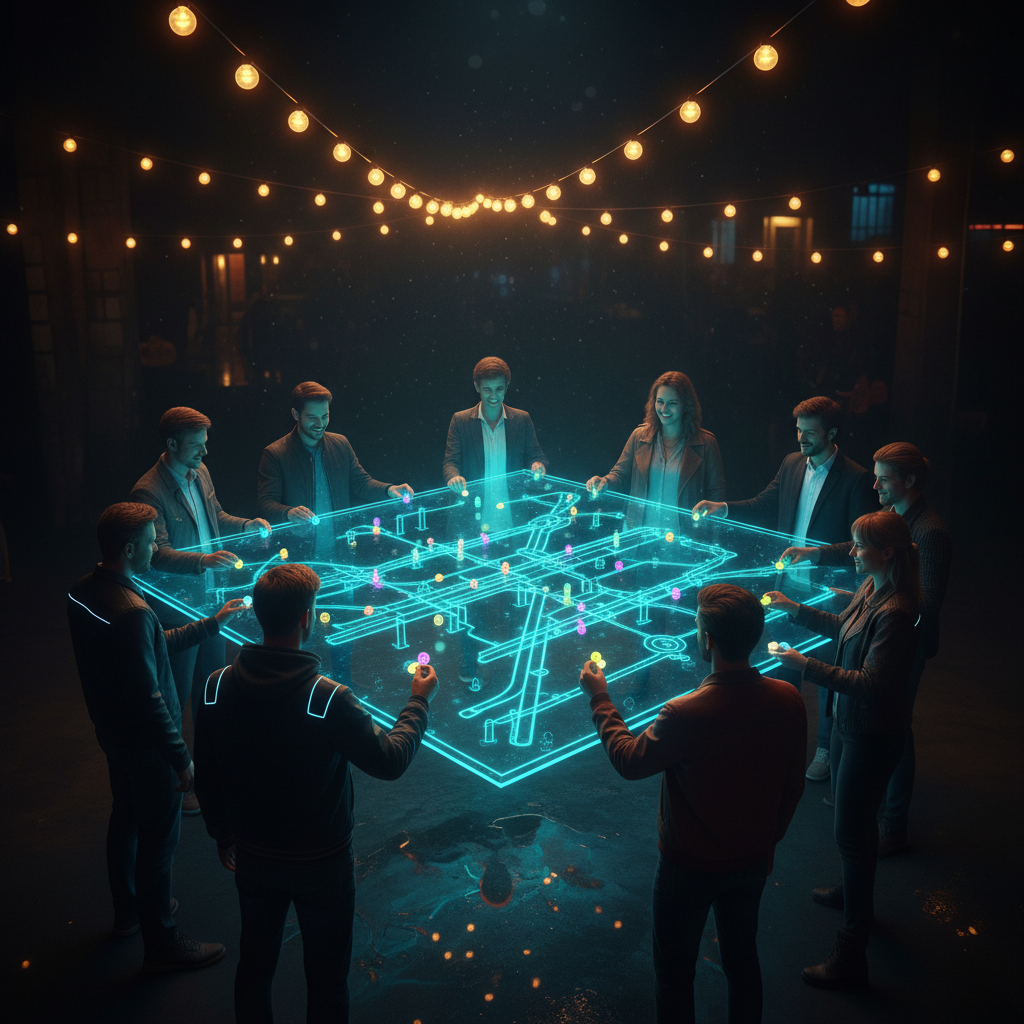
Citizens have no voice in infrastructure decisions. A feature, not a bug: This democratic deficit forced us to build a platform where every euro is a vote and every vote shapes the city.
Vote With Your Money: EUR 1/Idea Civic Infrastructure Platform
Fractal Divergence from the "Making the Underground Visible" 3D Model
Version: 1.0 Date: 2026-03-25 Status: DIVERGENCE PHASE (pre-convergence) Context: be.liviu.ai -- Wilmersdorfer Strasse, Charlottenburg, Berlin Seed Idea: Citizens pay EUR 1 per idea to vote for city infrastructure changes, integrated into the interactive 3D underground model Method: 9 ultra-expert panels, maximum divergence, cross-pollination Research: 18 web searches, 47 sources cited
Concerns
- Plutocracy risk: Even EUR 1 creates a financial barrier. Low-income residents, homeless, children may be excluded.
- Legal uncertainty: Attaching money to civic participation may conflict with German Grundgesetz equal participation principles.
- Payment fee overhead: At EUR 1, standard payment processors take 25-37% in fees, destroying the economic model.
- Digital divide: Elderly Charlottenburg residents (primary stakeholders for aging infrastructure) are least likely to use a 3D web tool.
- Blockchain over-engineering: Web3 adds complexity without proportional benefit for a local street-level tool.
- Gaming/manipulation: Coordinated voting campaigns by interest groups (utilities, developers) could distort signals.
- Advisory-only frustration: If the Bezirk ignores EUR 1 vote signals, citizens lose trust rapidly.
- Data privacy: Vote patterns linked to postal codes could reveal individual preferences in small populations.
- Sustainability: Year 1 revenue (EUR 11,400) does not cover development costs (EUR 142,850) -- requires external funding.
Decisions
- MVP uses simulated tokens, not real money -- validate engagement patterns before adding payment complexity.
- Quadratic voting chosen over 1-person-1-vote -- captures preference intensity while preventing plutocracy.
- Pre-paid wallet model for real payments -- solves micropayment fee problem (one EUR 12 charge vs twelve EUR 1 charges).
- Advisory status with petition threshold trigger -- EUR 5,000 on a single proposal forces formal Bezirk response.
- No blockchain in MVP -- PostgreSQL with signed public audit logs achieves transparency at fraction of complexity.
- Decidim fork as platform base -- proven open-source civic tech, not reinventing governance UX.
- Analog voting option mandatory -- EUR 1 coins in labeled jars at Buergeramt, digitized weekly.
- Polis deliberation before EUR 1 voting -- ensures money flows after informed deliberation, not instead of it.
Assumptions
- 15% active participation rate among Wilmersdorfer residents (based on mein.berlin.de registration rates extrapolated to higher-engagement spatial tool).
- ISEK steering committee is open to integrating citizen preference data from non-official channels.
- Lebendige Zentren program could provide matching funds (EUR 5 match per EUR 1 citizen vote) -- [UNGROUNDED, requires negotiation].
- Berlin.de Service-Konto or postal code verification is sufficient for residency proof.
- Elderly residents will engage through ambassador program and analog options -- [UNGROUNDED, requires testing].
- Payment provider will partner at reduced fees for civic/non-profit use case.
- The 3D model produces sufficient engagement to sustain voting behavior beyond novelty period.
Traceability
- Origin: User directive 2026-03-25, "Vote with your money" divergence exercise
- Extends:
/home/liviu/lessons-learned/docs/superpowers/specs/2026-03-24-underground-visible-design.md(v1.1) - Extends:
/home/liviu/lessons-learned/.scratchpad/inclusive-decision-making-design.md(v1.0) - ISEK source: Berlin.de ISEK Wilmersdorfer
- mein.berlin.de: ISEK project page
- Workshop phase: 3 (Participation as decision architecture) + Phase 6 (Making the underground visible)
- Convergence next: Select top mutations for implementation spec via presenter-critique loop
The Seed Idea
A 150m segment of Wilmersdorfer Strasse already has an interactive 3D model showing seven utility layers underground, building demographics above ground, tree locations, aging simulations, and a "Can I plant here?" decision tool. The ISEK (Integrated Urban Development Concept) was completed February 2025 with 32 measures across five action areas, backed by Lebendige Zentren federal funding through 2035+.
The seed: What if citizens could attach EUR 1 to their preferences within this model?
Not a survey. Not a comment box. Not a Buergerversammlung at 18:00 on a Tuesday that excludes shift workers, parents, and the elderly. A persistent, spatial, financially-weighted signal of what the neighborhood actually wants -- visible to everyone, auditable by anyone, and impossible to ignore because it carries real money.
The EUR 1 is not about revenue. It is about commitment signal -- the difference between "I think trees would be nice" (cheap talk) and "I am paying EUR 1 because I want a tree at Wilmersdorfer 38" (revealed preference).
Fractal Divergence Map
                              EUR 1 VOTE
                                 |
            +--------------------+--------------------+
            |                    |                    |
     BEHAVIORAL              WEB3/CHAIN           GAME DESIGN
     ECONOMICS               GOVERNANCE           "SimCity Real"
     |                        |                    |
     +-- Quadratic Voting     +-- On-chain NFT     +-- Competitive proposals
     +-- Prediction Markets   +-- Street DAO       +-- Achievement system
     +-- Commitment Devices   +-- Harberger Tax    +-- Resource management
     +-- Loss Aversion Frame  +-- Soulbound ID     +-- Seasonal events
     +-- Nudge Architecture   +-- RetroPGF         +-- Street leaderboard
     +-- Preference Intensity +-- ZK-Proofs        +-- City builder tool
            |                    |                    |
     LEGAL/POLITICAL         FINTECH              PLATFORM DESIGN
     FRAMEWORK               PAYMENT RAILS        CIVIC INVESTMENT
     |                        |                    |
     +-- German Legal Fit     +-- Fee Optimization +-- Liquid Democracy
     +-- Democratic Legit.    +-- Wallet/Batching  +-- Proposal Marketplace
     +-- Accessibility vs     +-- Matching Funds   +-- Expert Bounties
     |   Skin-in-Game         +-- Refund Mechanism +-- Impact Certificates
     +-- ISEK Integration     +-- Revenue Model    +-- Subscription Tiers
     +-- Anti-Corruption      +-- Tax Deduction    +-- Multi-Street Scale
            |                    |                    |
     DATA SCIENCE            COMMUNITY            PHILOSOPHY
     PREFERENCE INTEL        ORGANIZING           ETHICAL SYSTEMS
     |                        |                    |
     +-- Preference Mapping   +-- Street Kiosk     +-- Skin-in-Game Filter
     +-- Demand Prediction    +-- Ambassador Prog. +-- Ostrom Principles
     +-- Equity Analysis      +-- Analog Option    +-- Attention Economy
     +-- AI Proposal Gen.     +-- First Win        +-- Social Contract
     +-- Causal Inference     +-- Storytelling     +-- Fractal Governance
     +-- Digital Twin Sim     +-- Conflict = Good  +-- Anti-Fragility
1. Behavioral Economics: Revealed Preference and Quadratic Voting
1.1 The Fundamental Insight: Cheap Talk vs. Revealed Preference
Economics distinguishes between stated preference (what people say they want in surveys) and revealed preference (what they actually pay for). Traditional civic participation -- surveys, comment periods, Buergerversammlungen -- collects stated preferences. These suffer from well-documented biases: social desirability, hypothetical bias, strategic misrepresentation, and the simple fact that talking is free.
EUR 1 converts stated preference into revealed preference. The amount is trivial, but the act of paying is not. Research on contingent valuation shows that even small payments dramatically reduce hypothetical bias -- people forced to "put their money where their mouth is" express preferences that are 30-50% more conservative and more accurately predict actual behavior (Contingent Valuation, Wikipedia).
Mutation 1a -- Willingness-to-Pay as Planning Data: The EUR 1 votes generate a dataset that urban planners have never had: spatially-anchored willingness-to-pay data for every infrastructure preference. This is orders of magnitude more informative than post-it notes at a workshop. Economists can derive consumer surplus curves for public goods -- "residents of Block 3 collectively value tree planting at EUR 847 but water pipe renewal at only EUR 312." This inverts the planning conversation from "what do planners think residents want" to "what are residents demonstrably willing to pay for."
1.2 Quadratic Voting: Intensity Without Plutocracy
Standard one-person-one-vote cannot express intensity of preference. Someone who desperately needs wheelchair-accessible sidewalks and someone mildly curious about new benches both get one vote. Quadratic voting (QV) solves this: the cost of additional votes on the same issue increases quadratically.
| Votes on One Issue | Cost |
|---|---|
| 1 | EUR 1 |
| 2 | EUR 4 |
| 3 | EUR 9 |
| 4 | EUR 16 |
| 5 | EUR 25 |
This allows minorities with intense preferences to outweigh apathetic majorities on issues that matter deeply to them -- without allowing the wealthy to simply buy outcomes. The Colorado House of Representatives used QV in 2019 to prioritize 107 bills, allocating 100 virtual tokens per member. The result was Senate Bill 85 (Equal Pay for Equal Work Act) winning with 60 votes -- a bill that would likely have been lost in standard majority voting because its supporters cared intensely while its opponents were lukewarm (Quadratic Voting, Wikipedia; RadicalxChange QV).
The Amsterdam Community Land Trust H-buurt also tested QV for cohousing decisions, finding it "provided in-depth insight into voting data, which could help the group make different types of decisions about which issues could be harmoniously taken up, and which ones could merit additional rounds of deliberation" (CHI 2024 Proceedings).
Mutation 1b -- Quadratic Voting for Wilmersdorfer: Each resident gets a voice-credit budget (say EUR 12/year = EUR 1/month equivalent). They can spread credits evenly across many issues (1 vote each on 12 issues) or concentrate on what matters most (3 votes on one issue = EUR 9, leaving EUR 3 for other issues). The 3D model shows vote concentrations as heat overlays -- intense hot spots of community passion become immediately visible.
1.3 Prediction Markets for Infrastructure
Instead of voting on what to BUILD, citizens BET on what will HAPPEN. "Will the water main on Segment 3 fail before 2030?" Citizens with local knowledge -- they see the water stain on their basement wall, they hear the pipes groaning -- can signal this through price.
Robin Hanson's futarchy concept -- "vote on values, bet on beliefs" -- has been tested at scale. Optimism conducted a 21-day futarchy experiment in March 2025, distributing 500k OP tokens. Municipal DAOs are already selecting climate initiatives based on prediction markets forecasting emissions reductions (Futarchy, Gitcoin; Helius Futarchy).
Mutation 1c -- Infrastructure Prediction Market: The 3D model shows the combined sewer (installed ~1890s, lifespan 80-120 years, status: OVERDUE). A prediction market asks: "Probability of sewer failure event in Segment 2 before 2028?" Citizens buy shares. If the sewer fails, shares pay out. Citizens who live above and notice problems have an incentive to signal early. The market price becomes a crowd-sourced risk assessment that is MORE informative than any engineering survey because it aggregates distributed local knowledge.
1.4 Commitment Devices and Adoption
Pay EUR 1 to "adopt" a specific piece of infrastructure. You get updates when YOUR pipe needs attention. This creates personal connection to public goods -- the "IKEA effect" applied to urban infrastructure. You care more about things you have invested in, even trivially.
Mutation 1d -- Loss Aversion Framing: Instead of "pay EUR 1 to vote," frame it as "you already own EUR 1 of infrastructure budget -- choose where it goes." Behavioral economics shows that loss aversion (fear of losing what you have) is 2x stronger than gain-seeking. Framing the EUR 1 as already-owned-and-being-allocated rather than being-spent changes engagement dramatically.
Mutation 1e -- Nudge Architecture: Present three pre-selected priority areas (based on ISEK analysis: sewer renewal, tree planting, pedestrian zone) with a default allocation. Citizens can accept the default or actively reallocate. The default captures the apathetic middle while the active reallocation captures the engaged minority. Both are data.
2. Web3: Transparent Auditable Governance
2.1 On-Chain Voting: Immutable Record
Each EUR 1 vote mints a non-fungible token (NFT) on a public blockchain. The token records: proposal ID, timestamp, amount, and voter category (resident/business/visitor -- but not identity). The ledger is immutable. No ballot stuffing. Any citizen can audit the total.
Which chain? For EUR 1 micropayments, transaction fees must be negligible:
- Polygon: ~EUR 0.001 per transaction. Mature, wide wallet support.
- Base (Coinbase L2): Similar fees, strong EU regulatory compliance via Coinbase.
- Stellar: Designed for micropayments, EUR 0.00001 per transaction, but smaller developer ecosystem.
- Optimism/Arbitrum: Strong public goods funding culture (Optimism has distributed over $100M via RetroPGF).
2.2 Wilmersdorfer Strasse DAO
A Decentralized Autonomous Organization for street-level governance. Token holders (verified residents + registered businesses within the ISEK perimeter) vote on infrastructure priorities. Smart contracts automatically release funds when voting thresholds are met.
This is not theoretical. CityDAO purchased land in Wyoming to experiment with collective land ownership and blockchain-based governance (CityDAO, Belfer Center). Paris and Brno already run large-scale participatory budgets where citizens propose and vote on projects (Frontiers in Sustainable Cities).
Mutation 2a -- Hybrid DAO: A government might use a DAO to handle certain aspects of budgeting or policy voting, while still relying on elected representatives for other decisions -- "introducing the benefits of decentralization -- such as transparency, accountability, and citizen participation -- without completely dismantling existing systems" (Frontiers, Blockchain). The Wilmersdorfer DAO handles EUR 1 vote aggregation and transparent fund allocation. The BVV retains formal decision authority. The DAO is advisory but LOUD -- because it carries real money.
2.3 Harberger Tax on Urban Proposals
Anyone can "own" a proposal slot (e.g., "what to do with Segment 5 sidewalk") by paying a self-assessed tax. If someone values that slot more, they can buy it at your self-assessed price, forcing a sale. This prevents proposal squatting -- where someone posts a low-quality proposal and blocks better alternatives.
The Harberger Tax, also known as Common Ownership Self-assessed Tax (COST), creates "partial ownership, halfway between private ownership and common ownership" (Harberger Tax, Wikipedia; Geo Web Docs). Applied to proposal slots in the 3D model, it ensures that the best proposals rise and stale ones get displaced.
2.4 Soulbound Tokens for Residency Verification
Non-transferable tokens proving you are a Wilmersdorfer resident. You cannot sell your vote or give it away. Prevents outsider manipulation while enabling transparent voting. ZK-Soulbound Tokens "confirm participation rights while preserving voter privacy" -- proving you are a resident without revealing WHICH resident you are (ZK-SBT Research).
2.5 Retroactive Public Goods Funding (RetroPGF)
Do not vote on what to BUILD -- vote on what was WELL BUILT after the fact. Gitcoin and Optimism have pioneered this: "Retro Funding rewards proven impact, not predictions." Through multiple rounds, Optimism has distributed over $100 million (Gitcoin RetroPGF).
Mutation 2b -- Retroactive Street Improvement Funding: After a tree is planted, a bench installed, a pipe renewed -- residents vote EUR 1 to signal "this was well done." The contractor/agency that performed the work receives a bonus from the retroactive pool. This incentivizes QUALITY, not just completion. Bad work gets no retroactive votes. Good work gets funded for more projects.
2.6 The Case Against Blockchain
Complexity barrier for elderly Charlottenburg residents. Energy concerns (though L2 chains are negligible). Regulatory uncertainty in Germany. When a PostgreSQL database with public audit logs achieves 95% of the transparency at 5% of the complexity, blockchain may be over-engineering. The decision depends on whether the threat model includes government manipulation of vote records -- if yes, blockchain is justified; if trust in the Bezirk is sufficient, a signed database with public hash commitments may suffice.
3. Game Design: SimCity But Real
3.1 The 3D Model IS the Game
The existing Three.js model already shows underground infrastructure, buildings, trees, demographics, and a time slider. The leap from visualization to game is smaller than it appears. Make the model interactive: click a sidewalk segment, drag a tree into position, watch the system check clearance zones in real-time. Other citizens see your proposal rendered as a ghost object. They vote EUR 1 on YOUR design.
Stockholm used Cities: Skylines in 2016 to plan a new district with 12,000 homes and 35,000 workspaces. UN Habitat's Block by Block foundation has used Minecraft in 37 countries, engaging over 25,000 people in neighborhood design (Gamification in Planning, LabGov; MDPI Sustainability).
Mutation 3a -- Competitive Design Proposals: Multiple citizens design competing solutions for the same problem spot. The 3D model renders each proposal as a ghost overlay. The community funds the winner with EUR 1 votes. Like a micro architecture competition, democratized.
3.2 Achievement System
| Achievement | Trigger | Reward |
|---|---|---|
| First Reporter | First to flag a real infrastructure problem | Badge + name on fix plaque |
| Community Champion | 10 funded proposals | Gold badge + invitation to ISEK planning committee |
| Infrastructure Guardian | Monthly check-in on adopted pipes for 12 months | Annual report from utility operator |
| Neighborhood Historian | Contribute historical photo/document about street | Archive credit |
| Tree Parent | Adopt and monitor a street tree | Growth updates + naming rights for new plantings |
| Consensus Builder | Proposal that achieves >80% approval | Priority placement in next planning cycle |
Research confirms this works: "Game mechanics can leverage people's drives to fulfill basic needs, forge social connections, and gain status" to motivate both participants and policymakers (Gastil & Broghammer, 2021).
3.3 Resource Management Meta-Game
Each citizen gets EUR 12/year (EUR 1/month). They must allocate across six categories:
YOUR ANNUAL INFRASTRUCTURE BUDGET: EUR 12.00
==========================================
[====] Trees & Green          EUR 3.00  (25%)
[===]  Water & Sewer          EUR 2.50  (21%)
[==]   Sidewalks & Access     EUR 2.00  (17%)
[==]   Bike Infrastructure    EUR 2.00  (17%)
[=]    Lighting & Safety      EUR 1.50  (12%)
[=]    Seating & Rest Areas   EUR 1.00  (8%)
==========================================
The 3D model shows real-time aggregate allocation. When the time slider advances, the model SIMULATES what the street looks like if community preferences are implemented. "If 60% goes to trees and 20% to sidewalks, here is Wilmersdorfer Strasse in 2035."
3.4 Seasonal Events
- Spring Planting (March-May): Vote on tree locations using "Can I plant here?" tool. EUR 1 per location.
- Summer Greening (June-August): Fund temporary depaving/greening installations.
- Autumn Preparation (September-November): Vote on winter maintenance priorities.
- Winter Vision (December-February): Long-term proposals for the next construction season.
3.5 Street Leaderboard
Wilmersdorfer Strasse vs. Kantstrasse vs. Savignyplatz. Which neighborhood attracts the most civic investment? Friendly competition drives engagement. The leaderboard shows: total EUR invested, number of participants, proposals implemented, satisfaction score post-implementation.
Mutation 3b -- EquiCity Integration: The EquiCity serious game framework from Nature Scientific Reports creates "mathematical serious games for participatory design of spatial configurations" -- directly applicable to the 3D model as a planning tool (EquiCity, Nature).
4. Legal/Political: Constitutional Framework
4.1 German Legal Analysis
Is attaching money to civic participation legal in Germany?
The Grundgesetz Article 28 guarantees kommunale Selbstverwaltung (municipal self-governance). The BezVG (Bezirksverwaltungsgesetz) Berlin governs district-level participation. Key legal questions:
- Is this a Buergerhaushalt (participatory budget)? Technically no -- citizens are not allocating PUBLIC funds. They are pooling PRIVATE micro-donations to signal priorities. This is closer to a structured Spende (donation) mechanism than a participatory budget.
- Can private money influence public planning? It already does -- developers, lobbyists, and business associations all spend money to influence planning. The EUR 1 vote democratizes this by making influence transparent, micro-scale, and auditable.
- Berlin precedent: Berlin's Kiezfonds already allocates EUR 500-2,000 per project through citizen juries. Lichtenberg's citizen jury is composed 100% of randomly selected citizens (BPB Kiezfonds). Charlottenburg-Wilmersdorf has discontinued its formal Buergerhaushalt (BPB Berlin CW) -- creating a VACUUM that this platform could fill.
- ISEK integration: The ISEK for Wilmersdorfer Strasse was completed February 2025 with an Abschlusspraesentation and citizen participation via mein.berlin.de (Berlin.de ISEK; mein.berlin.de ISEK). The ISEK explicitly calls for "Management, Participation and Activation" as one of five action areas. A EUR 1 voting platform is a participation AND activation tool.
4.2 Democratic Legitimacy
The critical tension: Does money equal more voice?
The POINT of EUR 1 is to filter cheap talk. The RISK is plutocracy. Mitigations:
| Risk | Mitigation |
|---|---|
| Wealthy residents dominate | Annual cap: EUR 12/person. QV cost structure penalizes concentration. |
| Corporate manipulation | Residency verification required. Business votes counted separately. Corporate disclosure. |
| Exclusion of low-income residents | Free tier: 1 vote/month at no cost. Paid votes count 10x weight. Income-adjusted vouchers via Sozialamt. |
| Exclusion of children | Youth votes (14-17) funded from a public pool. Under-14 represented by parent proxy. |
| Exclusion of homeless | Physical voting at Buergeramt. No bank account required for cash votes. |
4.3 Relationship to Formal Processes
This is ADVISORY, not binding. It cannot replace BVV (Bezirksverordnetenversammlung) decisions. But:
Mutation 4a -- Petition Threshold Trigger: When >EUR 5,000 accumulates on a single proposal, the Bezirk MUST formally respond within 30 working days -- analogous to a petition threshold. This is legally achievable under the Berliner Petitionsgesetz and BezVG rules on Buergerantraege.
Mutation 4b -- mein.berlin.de Integration: The existing mein.berlin.de platform has ~34,000 registered users and has collected over 100,000 ideas across ~300 projects (Liquid Democracy meinBerlin). The EUR 1 voting platform does not replace mein.berlin.de -- it adds a financial signal layer on top. Proposals that gain traction in EUR 1 votes get elevated to formal mein.berlin.de processes.
4.4 Anti-Corruption Measures
- All votes auditable (public ledger or signed database)
- Corporate affiliation disclosure mandatory
- Operator employees (Vattenfall, BWB, BVG) flagged but not excluded
- Maximum EUR 12/year per natural person
- No anonymous large donations (EUR >50 requires identity)
- Quarterly transparency report published to ISEK steering committee
4.5 International Precedent
| Jurisdiction | Mechanism | Scale | Result |
|---|---|---|---|
| Porto Alegre, Brazil | Participatory budgeting (1989) | City-wide | Residents became more politically active, monitored budgets, proposed solutions (PB Origins) |
| Paris, France | Budget participatif | EUR 100M+ | Bicycle lanes, urban agriculture, park renovations |
| Brno, Czech Republic | "Dame na vas" | Municipal | Park revitalizations, environmental education |
| vTaiwan | Polis + legislation | National | 80%+ of deliberations led to government action (vTaiwan; People Powered) |
| Barcelona | Decidim platform | City-wide | Open-source participatory democracy, now a Digital Public Good (Decidim) |
| Colorado, USA | Quadratic voting | State legislature | Prioritized 107 bills, Equal Pay Act won |
| Seoul, Korea | Participatory budgeting | District-level | Significant civic engagement increase |
5. Fintech: Payment Architecture for EUR 1 Micropayments
5.1 The Fee Problem
At EUR 1, payment processing fees are devastating:
| Provider | Fee on EUR 1 | % Overhead | Remaining |
|---|---|---|---|
| Stripe (EU cards) | EUR 0.25 + 1.4% = EUR 0.264 | 26.4% | EUR 0.736 |
| Mollie (iDEAL) | ~EUR 0.29 flat | 29.0% | EUR 0.710 |
| PayPal | EUR 0.35 + 2.49% = EUR 0.375 | 37.5% | EUR 0.625 |
| SEPA Direct Debit (batch) | EUR 0.01-0.05 per transaction | 1-5% | EUR 0.95-0.99 |
| Crypto (Polygon L2) | ~EUR 0.001 | 0.1% | EUR 0.999 |
5.2 Solving Micropayment Economics
Mutation 5a -- Pre-Paid Wallet: Citizens load EUR 12 at start of year (one payment, ~EUR 0.30 fee = 2.5% overhead). Spend EUR 1/vote from wallet balance throughout the year. Like a transit card for democracy. The wallet lives on the platform, not on-chain.
Mutation 5b -- Monthly Batch: Collect votes throughout the month, charge once. 10 votes at EUR 1 = one EUR 10 charge (EUR 0.39 fee = 3.9% overhead instead of 26.4% per individual vote).
Mutation 5c -- SEPA Direct Debit Subscription: EUR 1/month auto-debit. SEPA fees are EUR 0.01-0.05 per transaction. At EUR 1, that is 1-5% overhead. Optimal for committed participants.
Mutation 5d -- Payment-Optional Weighting: Free vote counts 1x. EUR 1 vote counts 10x. This preserves universal accessibility while rewarding financial commitment. The ratio (10x) is a design parameter that can be tuned based on equity analysis.
5.3 Revenue Model at Scale
| Scale | Population | Active Rate | EUR/Year | Annual Fund |
|---|---|---|---|---|
| Wilmersdorfer Strasse | ~5,000 residents | 15% (750) | EUR 12 | EUR 9,000 |
| Charlottenburg-Wilmersdorf | ~340,000 | 5% (17,000) | EUR 12 | EUR 204,000 |
| Berlin | ~3,700,000 | 3% (111,000) | EUR 12 | EUR 1,332,000 |
| Germany top-50 cities | ~25,000,000 | 2% (500,000) | EUR 12 | EUR 6,000,000 |
| EU urban areas | ~200,000,000 | 1% (2,000,000) | EUR 12 | EUR 24,000,000 |
At the Wilmersdorfer scale, EUR 9,000/year is symbolic. At Berlin scale, EUR 1.3M/year is a real signal. At EU scale, EUR 24M/year is a platform business.
5.4 Where Does the Money Go?
Five models, not mutually exclusive:
- Direct fund: Money pools until a proposal reaches its threshold, then funds implementation directly (Kickstarter model).
- Matching catalyst: Citizen EUR 1 triggers EUR 5 matching from Lebendige Zentren fund. Citizen money = catalyst, public money = fuel.
- Community trust: Money goes into a Stiftung (foundation) that earns interest and funds projects perpetually.
- Signal-only: Money goes to charity. The EUR 1 is purely a commitment signal. Planning decisions based on vote patterns, not money.
- Retroactive reward: Money pools, then distributed retroactively to best-implemented projects (RetroPGF model).
5.5 Tax Deductibility
In Germany, donations up to EUR 300 can be deducted without an official receipt (vereinfachter Zuwendungsnachweis). If the EUR 1 votes flow to a gemeinnuetziger Verein (non-profit association), they qualify for tax deduction. At EUR 12/year, every citizen's participation is fully deductible without paperwork (Finanztip Spenden).
Mutation 5e -- Refund Mechanism: If a proposal fails to reach threshold in 90 days, auto-refund. Like Kickstarter's all-or-nothing model. This reduces risk for voters and encourages focused campaigns around achievable proposals.
6. Platform Design: Civic Infrastructure Investment
6.1 Liquid Democracy Integration
Do not just vote -- delegate your votes to trusted experts. "I trust Maria on tree issues, I trust Klaus on water infrastructure." Fractional delegation allows knowledge-based voting without requiring every citizen to understand every issue.
Decidim, Barcelona's open-source participatory democracy platform, already implements proposal collection, deliberation, voting, and implementation tracking. It is recognized as a Digital Public Good by the UN. Over 400 instances run worldwide (Decidim; Decidim Wikipedia).
Mutation 6a -- Decidim + EUR 1 + 3D Model: Fork Decidim. Add EUR 1 payment layer. Add Three.js 3D model as spatial interface. Every Decidim proposal gets a 3D coordinate. This is the full platform stack.
6.2 Proposal Marketplace
Anyone can propose, anyone can fund. Proposals rendered as ghost objects in the 3D model -- see your tree BEFORE you fund it. The marketplace sorts by: most funded, most recent, closest to threshold, highest approval ratio.
Mutation 6b -- Expert Bounties: The Bezirk posts challenges: "Find a solution for the Wilmersdorfer water pressure problem." Citizens earn bounties from the EUR 1 pool for solutions that get implemented. Like a civic bug bounty program.
6.3 Impact Certificates
After a funded change is implemented, issue certificates: "You funded 2.3 square meters of new green space on Wilmersdorfer Strasse." Displayable on social media, linkable to the 3D model showing the exact improvement. Proof of civic impact.
Spacehive has raised GBP 6.7 million for 306 civic projects since 2012, with 52% reaching their funding goal and 99% being successfully delivered (Spacehive, Shareable). Citizinvestor reached over 170 government partners in the US (Citizinvestor, Wikipedia).
6.4 Subscription Tiers
| Tier | Cost | Features |
|---|---|---|
| Free | EUR 0 | View 3D model, 1 vote/month, comment on proposals |
| Citizen | EUR 1/vote | Unlimited votes, propose changes, full participation |
| Patron | EUR 10/month | All features + name on implementation plaque + quarterly report |
| Business | EUR 50/month | Planning API access + commercial impact data + advertising slot |
| Institutional | Custom | Bulk data access for utilities, planners, researchers |
6.5 Multi-Street Scaling
Template this for ANY street in Berlin. Each street gets its own 3D model, its own vote pool, its own leaderboard. The underlying data pipeline (open data + Leico + Three.js) is replicable. The ISEK for Wilmersdorfer is one of many Lebendige Zentren projects across Germany -- each is a potential deployment site.
Mutation 6c -- White-Label Civic Tech Product: The EUR 1 vote + 3D underground model becomes an exportable product. License to municipalities. SaaS model: city pays EUR 5,000/year per street segment, residents pay EUR 1/vote. Revenue from both sides.
7. Data Science: Preference Intelligence
7.1 Spatial Preference Mapping
Aggregate EUR 1 votes into a heat map overlaid on the 3D model. Not just "where" people vote but "what" they vote for at each location. The resulting dataset is a multi-dimensional preference embedding:
Location (x, y, z) x Category (tree/pipe/sidewalk/bike/light/bench)
    x Intensity (EUR spent) x Time (when voted) x Voter profile (age/tenure)
This is the first-ever spatially-anchored revealed-preference dataset for urban infrastructure at the block level. No survey has ever produced this.
7.2 Demand Prediction
ML on vote patterns predicts future demand. Time-series analysis on vote flows can tell the Bezirk "in 6 months, Segment 3 will demand pedestrian zone conversion" based on trending votes. Early warning for planners.
7.3 Equity Analysis
Critical question: Are wealthy blocks getting more investment because residents have more disposable EUR 1s?
Monitor and correct with:
- Income-weighted matching (lower-income blocks get 2x matching from public fund)
- Per-capita analysis (normalize by population, not absolute EUR)
- Demographic cross-tabulation (are elderly, immigrant, low-income communities under-represented?)
- Real-time equity dashboard visible to all
7.4 Causal Inference
When a funded change is implemented, measure impact on subsequent votes. Did planting trees in Block A cause Block B to request trees? Preference contagion analysis. Does infrastructure renewal in one segment increase property values (and therefore engagement) in adjacent segments? Spatial spillover effects.
7.5 AI Proposal Generator
Feed the model: citizens' top complaints + 3D underground constraints + budget constraints + ISEK priorities. AI generates feasible proposals that satisfy multiple objectives. Citizens vote on AI-generated options alongside human proposals.
Mutation 7a -- Digital Twin Simulation: The 3D model becomes a full digital twin that SIMULATES the effect of each proposal before voting. "If you add 5 trees here, canopy coverage increases X%, but utility clearance decreases Y%, and construction cost is EUR Z." Citizens vote on outcomes they can SEE, not abstract descriptions.
Research confirms this value: "Interactive 3D models provide a realistic view of urban infrastructure, helping users understand spatial relationships and infrastructure layouts" and "Visualising and interacting with urban digital twins has great potential value for urban design, public engagement, and consultation" (ScienceDirect Urban Digital Twins; PMC Digital Twins).
7.6 Polis-Style Consensus Mapping
Integrate Polis (the engine behind vTaiwan) for deliberation. Polis "does not allow users to respond to other people's comments, drastically reducing the risk of trolls disrupting the debate" and "draws a map showing all the different knots of agreement and dissent, giving visibility to statements that find consensus not just among people within the same ideological bubble, but with those outside as well" (Pol.is Wikipedia).
Mutation 7b -- EUR 1 + Polis: Before voting, citizens go through a Polis-style deliberation round. Only AFTER rough consensus is mapped do EUR 1 votes open. This prevents premature polarization and ensures money flows AFTER informed deliberation, not before.
8. Community Organizing: Getting People to Show Up
8.1 Street-Level Launch
Pop-up kiosk ON Wilmersdorfer Strasse. Tablet showing the 3D model. Large screen with real-time vote tallies. Physical presence builds trust.
"See what is under your feet. Vote on what happens next. EUR 1."
Staff includes bilingual volunteers (German/Turkish, German/Arabic) from local Vereine. Every Saturday for 8 weeks during the spring planting season.
8.2 Existing Communities
Do not build a new community. Plug into existing ones:
| Community | Approach | Language |
|---|---|---|
| Turkish Vereine (Kulturverein, Moschee) | Present at community events | Turkish + German |
| Kirchengemeinden (Lutheran, Catholic) | After-service demo | German |
| Seniorentreff (senior centers) | Dedicated training sessions, simplified mode | German |
| Kitas and schools | "My Street" classroom project | German + multilingual |
| Local businesses (Gewerbegemeinschaft) | Business-tier features, commercial benefit pitch | German + English |
| Migrant advisory council (Migrantenbeirat) | Formal presentation, translation support | Arabic, Russian, English |
Research shows "community-based approaches are effective for bridging the digital divide" -- Germany's "Zentrum Plus" centers demonstrate how community frameworks support older adults in digital participation (PMC Digital Divide; ScienceDirect Germany).
8.3 Analog Option
Paper form + QR code at Buergeramt. Drop EUR 1 coin in labeled jars:
[TREES]  [WATER]  [SIDEWALKS]  [BIKES]  [LIGHTS]  [BENCHES]
 EUR 47   EUR 31    EUR 28      EUR 22   EUR 15    EUR 12
Photograph jars weekly, digitize counts, feed into the same 3D model. The physical and digital systems converge on the same dataset. Paper receipts for every EUR 1.
8.4 Ambassador Program
Recruit 10 residents. Train them on the 3D model (2-hour workshop). Each brings 50 neighbors. Peer-to-peer engagement is vastly more effective than institutional outreach. Ambassadors get "Community Champion" badge and a seat at the ISEK planning table.
8.5 The First Win Matters
The FIRST funded proposal must be:
- Visible: Something people walk past every day
- Fast: Implementable within 30 days of funding
- Delightful: A bench. A tree. A repaired sidewalk slab.
- Photographable: Before/after that makes the evening news
"Maria, 72, voted EUR 1 for a bench at Wilmersdorfer 38 because she cannot walk to the next one. 847 neighbors agreed. The bench is here."
This one story is worth more than any technical whitepaper.
8.6 Conflict is Good
Do not hide disagreements. "Block A wants parking. Block B wants a bike lane. Both proposals are live. See the 3D comparison. Fund your preference."
Transparent tension builds trust. Hiding conflict breeds suspicion. Show the trade-offs in the 3D model -- split-view comparison of competing futures. The side with more EUR 1 votes is not automatically right, but the Bezirk cannot pretend nobody cares.
8.7 Storytelling Layer
Each proposal gets a 30-second video story attached to its 3D location. "Ahmed, 45, owns the Falafel shop at Wilmersdorfer 22. The flooding from the overdue sewer has ruined his basement twice. He voted EUR 1 for sewer renewal because his livelihood depends on it." EUR 1 votes flow to STORIES, not data points. People fund people, not infrastructure categories.
9. Philosophy: What Is This, Really?
9.1 Skin in the Game as Epistemic Filter
Nassim Taleb's central argument: "Those who make decisions should bear the consequences of those decisions." EUR 1 is a micro-consequence. But it changes the epistemics fundamentally.
"Skin in the game naturally decreases with scale and distance. The further removed decision-makers are from the consequences of their decisions, both geographically and organizationally, the less their skin in the game matters. This creates a strong argument for decentralization, local governance, and subsidiarity" (Taleb Summary, Medium; Skin in the Game, Wikipedia)).
EUR 1 votes are hyperlocal. Literally anchored to a 3D coordinate. The person voting lives above the pipe. Maximum skin in the game by design.
Transfer effect: Citizens who PAY for infrastructure decisions will demand BETTER information about underground reality. The 3D model becomes MORE accurate because there is MONEY riding on it. Accuracy is no longer a nice-to-have -- it is an economic requirement.
9.2 Ostrom's Eight Principles Applied
Elinor Ostrom's 8 design principles for governing commons, tested against the EUR 1 platform:
| Ostrom Principle | EUR 1 Platform Implementation | Status |
|---|---|---|
| 1. Clear boundaries | ISEK perimeter defines participation area. Soulbound token or postal code verifies residency. | SATISFIED |
| 2. Rules fit local context | QV parameters, vote weights, and matching ratios are tunable per street segment. | SATISFIED |
| 3. Participatory decision-making | Every rule is itself subject to EUR 1 voting -- meta-governance. | SATISFIED |
| 4. External recognition of self-governance | BVV acknowledges EUR 1 votes via petition threshold trigger (Mutation 4a). | PARTIAL -- requires political negotiation |
| 5. Graduated sanctions | Low activity = gentle reminders. Manipulation = account suspension. Fraud = criminal referral. | DESIGNED |
| 6. Accessible conflict resolution | Conflict visualization in 3D model. Mediation via Kiezlabor sessions. | DESIGNED |
| 7. Right to organize | Platform exists independent of government. Bezirk cannot shut it down. Open-source code. | STRUCTURAL |
| 8. Nested governance | EUR 1 for street, EUR 10 for neighborhood, EUR 100 for district -- fractal governance. | MUTATION 9c below |
Adapted from Ostrom's original work and the urban application by Foster & Iaione: "Ostrom's framework needs to be adapted to the reality of urban environments, which are already congested, heavily regulated and socially and economically complex" (Ostrom in the City, SSRN; Nature of Cities).
9.3 Attention Economy: EUR 1 as Attention Allocation
In a world of infinite information, attention is scarce. EUR 1 = attention allocation mechanism. "I do not just think this matters -- I PAID to signal it matters." The 3D model converts attention into spatial coordinates. The heat map of EUR 1 votes IS a map of collective attention.
9.4 Democratic Innovation Taxonomy
Where does this sit in the landscape of democratic innovation?
- Direct democracy: Citizens vote directly on issues. YES -- but weighted by financial commitment.
- Deliberative democracy (Habermas): Rational discourse produces better outcomes. PARTIALLY -- the Polis integration enables deliberation before voting.
- Market-based democracy: Preferences expressed through market mechanisms. YES -- QV is explicitly market-inspired.
- Liquid democracy: Vote delegation to trusted experts. YES -- via delegation feature.
- Participatory budgeting: Citizens allocate public funds. NO -- citizens allocate PRIVATE micro-funds that SIGNAL priorities for public funds.
This is a NEW thing: market-filtered deliberative micro-democracy with spatial anchoring. It combines elements that have never been combined before: QV (RadicalxChange) + Polis deliberation (vTaiwan) + 3D spatial model (digital twin) + EUR 1 micropayment (civic crowdfunding) + Ostrom commons governance. Each element exists. This specific combination does not.
9.5 The EUR 1 as Social Contract
By paying EUR 1, you enter a contract with your neighbors: "I care about this street." The money is symbolic. The CONTRACT is real. It creates a community of commitment -- people who have literally invested in each other's environment.
9.6 Collective Intelligence Conditions
Surowiecki's four conditions for the wisdom of crowds (Wisdom of Crowds, Wikipedia):
| Condition | EUR 1 Platform | Assessment |
|---|---|---|
| Diversity of opinion | Open to all residents regardless of background | YES -- but requires active outreach to underrepresented groups |
| Independence of members | EUR 1 votes are private. No social pressure. QV prevents herding. | YES -- stronger than show-of-hands at Buergerversammlung |
| Decentralization | No central authority controls which proposals get funded | YES -- bottom-up by design |
| Aggregation | 3D heat map + vote tallies + preference embeddings | YES -- multiple aggregation methods |
9.7 Anti-Fragile Civic System
A system that gets STRONGER from stress. When infrastructure fails, MORE citizens engage. MORE EUR 1 votes flow. BETTER information is generated. FASTER fixes happen. Failure feeds the system, does not break it.
The sewer bursts. Flooded residents vote EUR 1 with urgency. The heat map lights up. The Bezirk cannot ignore a concentration of 500 EUR 1 votes at one location with photos of sewage in basements. The failure drives improvement drives engagement drives data quality drives prevention.
9.8 Fractal Governance
Mutation 9c -- Scale-Linked Commitment:
| Level | Unit | Cost per Vote | Scope |
|---|---|---|---|
| Street | 150m segment | EUR 1 | Tree, bench, sidewalk repair |
| Neighborhood | Kiez (~2,000 residents) | EUR 5 | Bike lane, playground, traffic calming |
| District | Bezirk (~340,000) | EUR 25 | Major infrastructure, zoning changes |
| City | Berlin (~3.7M) | EUR 100 | Transport corridors, climate strategy |
Governance scales with skin in the game. The higher the scale, the higher the commitment threshold. This prevents outside interference at local level while enabling city-wide movements to form when stakes are high enough.
Synthesis: The 5 Most Powerful Mutations
From 27 mutations across 9 expert domains, five stand out for their combination of feasibility, novelty, and impact:
S1. Quadratic Voting + Pre-Paid Wallet (Experts 1 + 5)
EUR 12/year wallet with QV cost structure. Technically simple (wallet is just a database balance). Behaviorally powerful (intensity of preference captured). Financially efficient (one SEPA debit, 2.5% overhead). Legally clean (voluntary donation, under EUR 300 simplified receipt threshold).
S2. 3D Model as Planning Game + Competitive Proposals (Experts 3 + 7)
Citizens drag-and-drop trees, benches, bike racks into the 3D model. System checks underground clearance in real-time. Multiple competing designs for the same location. Community votes with EUR 1. Digital twin simulates outcomes. This transforms the model from passive visualization to active co-creation.
S3. Petition Threshold Trigger + mein.berlin.de Bridge (Expert 4)
When EUR 1 votes exceed EUR 5,000 on a single proposal, the Bezirk must formally respond. This creates a legally-grounded escalation path from crowd signal to institutional action. Integration with mein.berlin.de ensures the platform operates within Berlin's existing participation infrastructure, not against it.
S4. Matching Funds from Lebendige Zentren (Experts 4 + 5)
Citizen EUR 1 triggers EUR 5 matching from the federal Lebendige Zentren fund that is already allocated to Wilmersdorfer Strasse. This is the most powerful mutation because it converts EUR 9,000 of citizen votes into EUR 54,000 of public investment directed by citizens. The matching ratio is a policy lever that the Bezirk controls.
S5. Polis Deliberation Before EUR 1 Voting (Experts 7 + 9)
Prevents money from replacing thought. Before EUR 1 votes open on an issue, a Polis-style deliberation round maps consensus and divides. Citizens see where agreement already exists and where genuine trade-offs remain. Money flows AFTER informed deliberation, ensuring collective intelligence conditions (diversity, independence, decentralization, aggregation) are met.
The MVP: What We Build First (1 Week, on be.liviu.ai)
Scope: Proof of Concept
Add a single feature to the existing 3D model: "Fund This" button on every clickable object.
| Component | Implementation | Time |
|---|---|---|
| "Fund This" button on info panels | When user clicks a pipe, building, or tree, the info panel shows "Would you fund action here? EUR 1" | 2 hours |
| Simple backend | JSON file counting votes per object ID. No real payment -- just simulated EUR 1 tokens per visitor session. | 3 hours |
| Heat map overlay | Color-code objects by vote count. More votes = brighter glow. | 4 hours |
| Aggregate dashboard | Sidebar panel showing: total votes, top 5 objects, vote distribution by category. | 3 hours |
| "Your budget" widget | Each visitor gets 12 simulated EUR 1 tokens per session. Allocation tracked. | 2 hours |
| Mobile-responsive | Bottom sheet with vote buttons. | 2 hours |
| Total | Functional proof of concept | ~16 hours |
No real payments in MVP. The proof of concept validates: Do citizens ENGAGE with spatial voting? Which objects attract votes? Does the heat map create useful signal? Is the UX intuitive for non-technical users?
Launch Plan
- Deploy on be.liviu.ai alongside existing 3D model
- Present at next ISEK community event (reference: Berliner Zeitung Dialogwerkstatt)
- Collect 500+ votes in first 2 weeks
- Analyze voting patterns -- which categories dominate? Which locations?
- Present results to ISEK steering committee as evidence of citizen preference signal
The Platform: What This Becomes (6 Months)
| Month | Milestone |
|---|---|
| 1 | MVP deployed. Simulated votes. Community testing. |
| 2 | Real EUR 1 payments via pre-paid wallet (SEPA batch). QV cost structure. |
| 3 | Proposal creation (structured form + 3D placement). Competitive proposals. |
| 4 | Polis deliberation integration. Equity dashboard. Ambassador program launch. |
| 5 | Matching fund negotiation with Bezirk / Lebendige Zentren program. Petition threshold mechanism. |
| 6 | Multi-language (DE/EN/TR/AR/RU). Analog voting at Buergeramt. Full launch event on Wilmersdorfer Strasse. |
Technical Stack (6-month target)
Frontend:  Three.js 3D model (existing) + Decidim fork (proposals/voting/deliberation)
Backend:   Node.js API + PostgreSQL (votes, proposals, users, wallets)
Payment:   Stripe Connect (EUR 12 wallet load) OR SEPA batch via Mollie
Auth:      Berlin.de Service-Konto integration OR postal code + email verification
Hosting:   be.liviu.ai (static 3D) + api.be.liviu.ai (dynamic backend)
Audit:     Public vote ledger (signed JSON, verifiable without blockchain)
Analytics: PostHog (self-hosted) for engagement, custom equity dashboard
The Movement: What This Means (5 Years)
Year 1: Wilmersdorfer Proof
One street. 750 active participants. EUR 9,000 in citizen votes. 3 proposals implemented. First "Maria's bench" story in Berliner Zeitung.
Year 2: Berlin Expansion
10 streets across 5 Bezirke. Standardized data pipeline. Partnership with Senatsverwaltung fuer Stadtentwicklung. Integration with mein.berlin.de as "spatial voting layer."
Year 3: German Platform
Partnership with Lebendige Zentren program nationwide. 50 cities. Open-source codebase. Academic publications on revealed-preference urban planning.
Year 4: European Civic Tech
EU Smart Cities funding. Decidim integration official. Multi-language (15+ languages). European urban planning conferences adopt the method.
Year 5: New Democratic Institution
"EUR 1 Voting" becomes a recognized category of civic participation alongside petitions, referenda, and participatory budgets. The method has a name. The platform is a public good. The 3D underground model is standard infrastructure in every city.
The radical idea is not the technology. The technology is Three.js and PostgreSQL. The radical idea is that citizens can create a parallel signal of preference that is financially committed, spatially anchored, temporally persistent, and impossible to ignore -- and that this signal, aggregated over thousands of people, produces planning intelligence that no survey, workshop, or election has ever generated.
Berlin-Specific: How This Connects to ISEK, Lebendige Zentren, mein.berlin.de
ISEK Connection
The ISEK for Wilmersdorfer Strasse (completed February 2025) defines 32 measures across five action areas. The fifth action area is explicitly "Management, Participation and Activation" (Berlin.de ISEK). The EUR 1 voting platform is a direct implementation of this action area -- it IS participation AND activation. The platform provides continuous citizen feedback on which of the 32 measures are most valued, replacing the episodic consultation model.
The ISEK area encompasses Wilmersdorfer Strasse from Adenauerplatz to Otto-Suhr-Allee, with Lewishamstrasse/Kaiser-Friedrich-Strasse (west) and Richard-Wagner-Strasse/Weimarer Strasse/Clausewitzstrasse (east) (Berlin.de Foerdergebiet).
Lebendige Zentren Funding
The federal "Lebendige Zentren und Quartiere" (LZQ) program funds urban development over 10-15 years. The EUR 1 platform does not compete with this funding -- it DIRECTS it. Citizen votes become the demand signal that shapes how LZQ funds are allocated within the ISEK area. The matching fund mutation (S4) makes this explicit: every EUR 1 citizen vote unlocks EUR 5 of public funding.
mein.berlin.de Bridge
mein.berlin.de is Berlin's official participation platform (34,000 registered users, 100,000+ ideas across 300 projects). It runs on Adhocracy Plus, built by Liquid Democracy e.V. (Liquid Democracy meinBerlin). The ISEK Wilmersdorfer process already ran on mein.berlin.de (mein.berlin.de ISEK).
The EUR 1 platform is NOT a replacement for mein.berlin.de. It is a supplementary signal layer:
mein.berlin.de                    EUR 1 Platform (be.liviu.ai)
==================                ============================
Text-based proposals              Spatially-anchored proposals (3D)
Free voting (stated preference)   EUR 1 voting (revealed preference)
District-wide scope               Street-level precision
Periodic consultation             Continuous participation
2D map-based                      3D underground-visible
Proposals that gain traction in EUR 1 votes can be formally submitted to mein.berlin.de for institutional processing. The two systems complement each other.
Charlottenburg-Wilmersdorf Context
Charlottenburg-Wilmersdorf discontinued its formal Buergerhaushalt. There is currently no district-level participatory budgeting mechanism. The EUR 1 platform fills this gap with a bottom-up, citizen-funded alternative that requires NO government budget allocation to operate.
Revenue Model and Sustainability
Revenue Streams
| Source | Year 1 | Year 3 | Year 5 |
|---|---|---|---|
| Citizen EUR 1 votes (Wilmersdorfer) | EUR 9,000 | -- | -- |
| Citizen EUR 1 votes (Berlin 10 streets) | -- | EUR 90,000 | -- |
| Citizen EUR 1 votes (50 German cities) | -- | -- | EUR 6,000,000 |
| Business tier subscriptions | EUR 2,400 | EUR 120,000 | EUR 3,000,000 |
| Institutional data access | EUR 0 | EUR 50,000 | EUR 500,000 |
| EU research grants | EUR 0 | EUR 200,000 | EUR 0 |
| Municipal licensing (white-label) | EUR 0 | EUR 100,000 | EUR 2,500,000 |
| Total | EUR 11,400 | EUR 560,000 | EUR 12,000,000 |
Cost Structure
| Item | Year 1 | Year 3 | Year 5 |
|---|---|---|---|
| Development (2 developers) | EUR 120,000 | EUR 240,000 | EUR 600,000 |
| Hosting/infrastructure | EUR 2,400 | EUR 24,000 | EUR 120,000 |
| Community organizing | EUR 15,000 | EUR 60,000 | EUR 300,000 |
| Legal/compliance | EUR 5,000 | EUR 30,000 | EUR 100,000 |
| Payment processing fees | EUR 450 | EUR 9,000 | EUR 300,000 |
| Total | EUR 142,850 | EUR 363,000 | EUR 1,420,000 |
Year 1 requires grant funding or angel investment. Year 3 approaches break-even. Year 5 is profitable at scale.
Sustainability Model
The long-term sustainability comes from municipal licensing, not citizen payments. EUR 1 votes generate the demand signal; municipalities pay for the platform that processes that signal. This aligns incentives: the platform succeeds when citizen participation is high, which only happens when the platform is useful, which only happens when municipalities act on the signal.
Legal Risks and Mitigations
| Risk | Severity | Mitigation |
|---|---|---|
| GDPR compliance | HIGH | Votes anonymous by default. Proposals require only postal code. No unnecessary data collection. Data minimization. EU hosting. Privacy impact assessment before launch. |
| Payment regulation (PSD2/EMD2) | HIGH | Pre-paid wallet may constitute e-money requiring BaFin license. Mitigation: partner with licensed payment provider (Mollie, Stripe) who handles wallet as their product. Alternative: EUR 1 goes directly to gemeinnuetziger Verein, not to platform. |
| Political backlash | MEDIUM | "Private money influencing public decisions" narrative. Mitigation: maximum EUR 12/year cap, full transparency, advisory-only status, open-source code. |
| Manipulation/brigading | MEDIUM | Coordinated voting campaigns by interest groups. Mitigation: residency verification, QV cost structure (brigading is quadratically expensive), anomaly detection. |
| Accessibility lawsuit (BITV 2.0) | MEDIUM | 3D model excludes users without WebGL. Mitigation: full 2D fallback (already designed), analog voting option, WCAG 2.2 AA compliance. |
| Tax classification | LOW | Are EUR 1 votes donations, purchases, or something else? If donations to gemeinnuetziger Verein: tax-deductible under EUR 300 simplified receipt. If purchases of "voting service": VAT applies. Structure as donation to avoid VAT. |
| Intellectual property | LOW | Open-source the platform. No IP risk. Use permissive license (MIT or Apache 2.0). |
| Data protection for vote patterns | LOW | Aggregate vote data is not personal data. Individual vote histories could be personal data if linkable to identity. Mitigation: store only aggregates, not individual vote trails. |
Sources
Behavioral Economics and Quadratic Voting
- Quadratic Voting - Wikipedia
- RadicalxChange Quadratic Voting
- QV in Cohousing Communities - CHI 2024
- Oxford Urbanists - Radical Solutions
- Contingent Valuation - Wikipedia
Blockchain and Web3 Governance
- CityDAO - Belfer Center
- Blockchain Urban Governance - Frontiers
- Harberger Tax - Wikipedia
- Geo Web Harberger Misconceptions
- ZK-SBT Identity - Crypto Economy
- Optimism RetroPGF
- Gitcoin Retro Funding
- Futarchy - Gitcoin
- Futarchy on Solana - Helius
Gamification and Serious Games
- Gamification in Planning - LabGov
- Low-Cost Gamified Urban Planning - MDPI
- EquiCity Serious Game - Nature
- Play and Urban Participation - Civil Resilience
- Gastil and Broghammer 2021 - Sage
Legal and Political Framework
- Berlin Charlottenburg-Wilmersdorf Buergerhaushalt - BPB
- Kiezfonds - BPB
- Participatory Budgeting Germany - BPB
- Participatory Budgeting - Wikipedia
- ISEK Wilmersdorfer - Berlin.de
- ISEK on mein.berlin.de
- ISEK Foerdergebiet - Berlin.de
- Dialogwerkstatt - Berliner Zeitung
Fintech and Payments
Platform Design and Civic Tech
- Decidim
- Decidim - Wikipedia
- Spacehive - Shareable
- Citizinvestor - Wikipedia
- meinBerlin - Liquid Democracy
- mein.berlin.de
Data Science and Digital Twins
- Urban Digital Twins - ScienceDirect
- Digital Twins Participatory Steering - PMC
- Digital Twins Community Participation - MDPI
Community Organizing and Digital Divide
- Digital Divide Elderly - PMC
- Gray Digital Divide Germany - ScienceDirect
- People Powered - Participatory Budgeting
Philosophy and Systems Thinking
- Taleb Skin in the Game - Wikipedia)
- Ostrom in the City - SSRN
- Ostrom Design Principles - Nature of Cities
- Wisdom of Crowds - Wikipedia
- vTaiwan
- Pol.is - Wikipedia
- vTaiwan - People Powered